Ctrl K
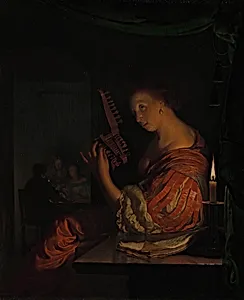
**Frans van Mieris the Elder (1635–1681)** was a leading Dutch Golden Age painter renowned for his meticulously detailed genre scenes and portraits. Born on 16 April 1635 in Leiden to a family of goldsmiths, he initially trained in his father’s trade before pursuing art. His early drawing instruction came from Abraham Toorenvliet, after which he studied under the renowned fijnschilder Gerrit Dou, who famously called him “the prince of his pupils.” He also briefly apprenticed with Abraham van den Tempel to develop a broader brush technique before returning to Dou’s precise, small-scale approach.
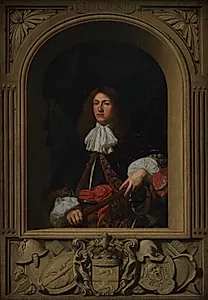
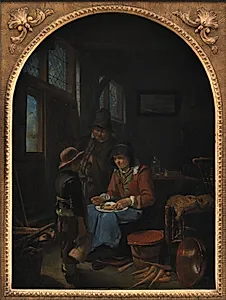
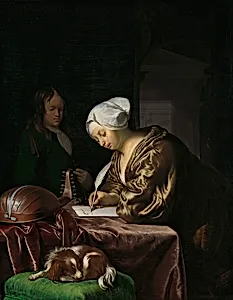
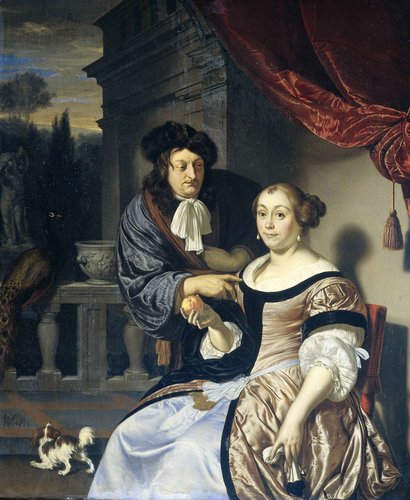
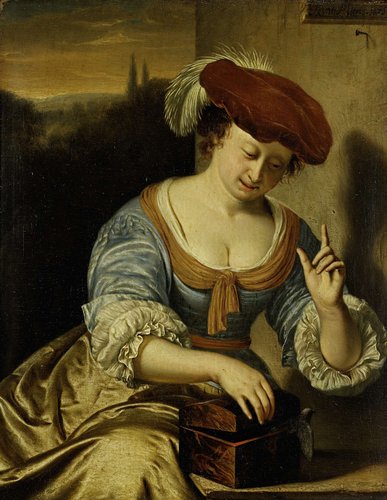
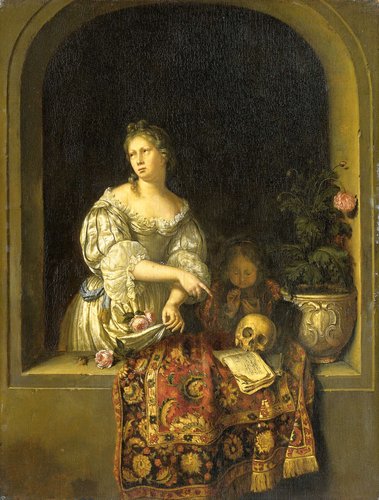
Van Mieris worked in the Leiden fijnschilder tradition of highly finished, enamel-like paintings on small panels, typically no larger than 12–15 inches. His style blended Dou’s meticulous detail with influences from Gerard ter Borch’s elegant satin textures and Adriaen van Ostade’s lively genre subjects. He specialized in scenes of everyday life among the wealthy—oyster meals, doctor’s visits, and musical lessons—rendered with a characteristic shiny, metallic polish and rich fabrics. He also painted portraits and occasional allegories.
Among his notable works are the *Doctor’s Visit* (1656/57, Kunsthistorisches Museum, Vienna), the *Oyster Luncheon* (Hermitage, St. Petersburg), *Young Woman Stringing Pearls* (1658), and the *Allegory of Painting* (c. 1661, J. Paul Getty Museum). He enjoyed prestigious patrons including Archduke Leopold Wilhelm and Cosimo III de’ Medici, Grand Duke of Tuscany, who commissioned multiple pieces. Van Mieris joined the Leiden Guild of Saint Luke in 1658 and married Cunera van der Cock the previous year; their sons Jan (1660–1690) and Willem (1662–1747), as well as grandson Frans van Mieris the Younger, continued the family painting tradition.
Van Mieris died in Leiden on 12 March 1681 at age 45. Though his successors never quite matched his technical brilliance and popularity, his refined fijnschilder technique and engaging domestic scenes left a lasting mark on Dutch Golden Age painting, with works now held in major collections worldwide.