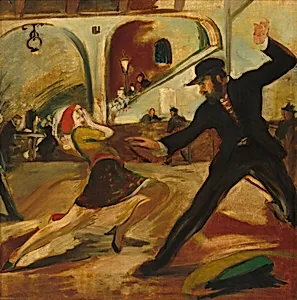
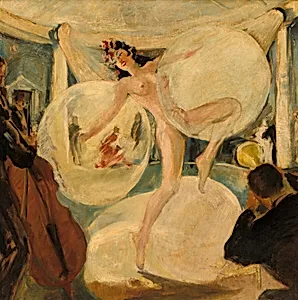
Franz Kline (1910–1962) was born on May 23 in Wilkes-Barre, Pennsylvania, a gritty coal-mining town in the heart of the state's industrial region. His early life was marked by tragedy: at age seven, his father, a saloon keeper, died by suicide, prompting his mother to remarry and enroll him in Girard College, a Philadelphia academy for fatherless boys. Kline later attended Lehighton High School, where he honed his drawing skills as the school newspaper's cartoonist. He pursued formal training at Boston University's School of Art from 1931 to 1935, supplementing this with night classes at the Boston Art Students League, before traveling to London for studies in drafting and illustration at Heatherley School of Fine Art from 1935 to 1938. There, he met his wife, Elizabeth V. Parsons, a British ballet dancer who accompanied him back to New York in 1938.
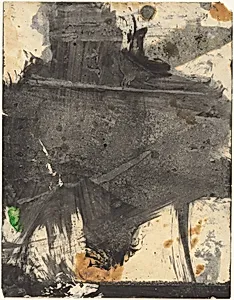
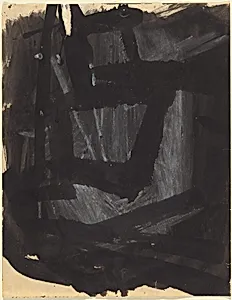
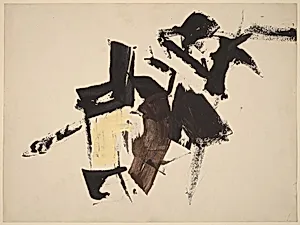
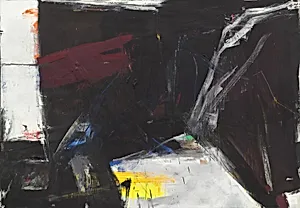
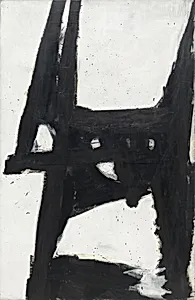
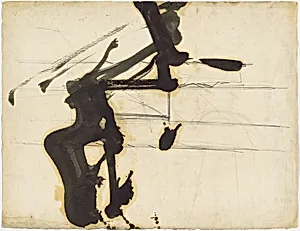
Settling in New York City, Kline initially worked as an illustrator and muralist, producing figurative landscapes, cityscapes, and portraits influenced by Old Masters like Rembrandt. A pivotal friendship with Willem de Kooning in 1943 immersed him in the Cedar Bar scene alongside Jackson Pollock and others in the nascent New York School. The breakthrough came around 1948 when de Kooning suggested projecting a small ink drawing of a rocking chair via an enlarger, transforming delicate lines into monumental black strokes that obliterated representation. By 1950, Kline debuted his signature Abstract Expressionist style at Charles Egan Gallery: vast black-and-white canvases executed with house-painter brushes, evoking raw energy through bold, calligraphic gestures on white grounds. He emphasized the interplay of forms—"I paint the white as well as the black"—aligning with action painting while nodding to his Pennsylvania roots in locomotives and steel structures.
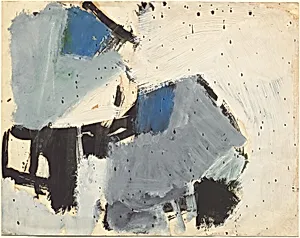
Kline's mature oeuvre includes iconic works like *Chief* (1950), *Nijinsky* (1950), *Painting Number 2* (1954), *Sabra* (1956), and *Requiem* (1958), alongside later color experiments such as *Probst I* (1960). He taught at Black Mountain College in summer 1952 and Pratt Institute night school from 1953 to 1954, and his paintings featured in the Venice Biennale (1956, 1960), MoMA's *The New American Painting* tour (1958), and Whitney Annuals. Though his wife suffered a mental breakdown requiring institutionalization, Kline's focus remained on art until his death from rheumatic heart disease on May 13, 1962, in New York at age 51. Revered as a cornerstone of Abstract Expressionism, his architectonic abstractions influenced Minimalists like Donald Judd and Robert Serra, bridging gestural freedom with structural rigor. Today, his works anchor collections at MoMA, the Whitney, and the Met, embodying the post-war American spirit.

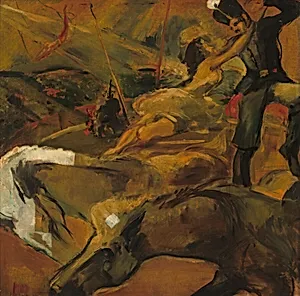
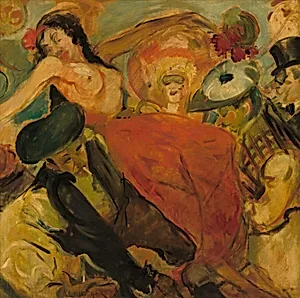
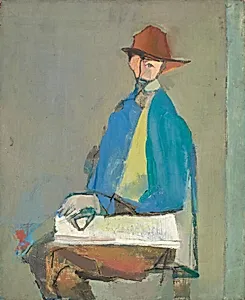
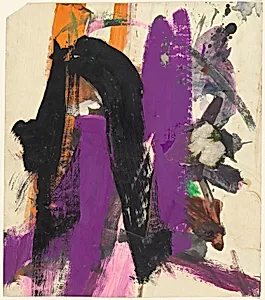
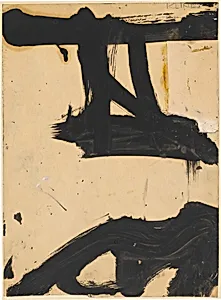
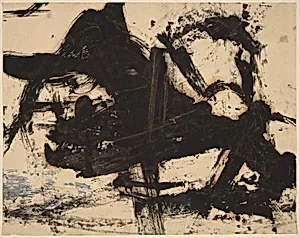
![Untitled [recto]](https://images.artheonmuseum.org/nga/thumb/untitled-recto-nga-79412.webp)
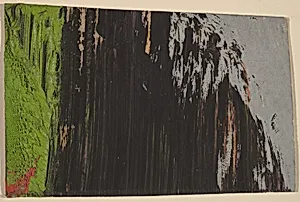
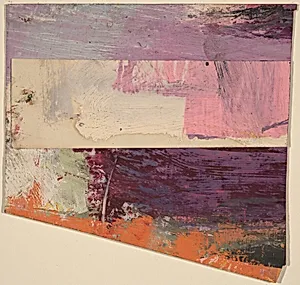
![Untitled [verso]](https://images.artheonmuseum.org/nga/thumb/untitled-verso-nga-108230.webp)
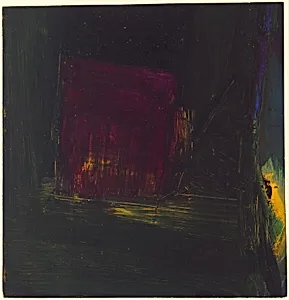
![Untitled [verso]](https://images.artheonmuseum.org/nga/thumb/untitled-verso-nga-108234.webp)