
Ctrl K
1751–1781
Franz Schütz (1751–1781) was a German painter, draughtsman, and engraver whose brief career bridged the late Rococo and early Neoclassical periods in European art. Born in Frankfurt am Main in 1751, Schütz emerged from the vibrant artistic milieu of Hessen, a region known for its patronage of the arts during the Enlightenment era. His life ended prematurely in Geneva, Switzerland, in 1781, at the age of just 30, leaving behind a modest but intriguing body of work that reflects the transitional tastes of mid-18th-century Germany. While details of his personal life remain elusive, records from institutions like the Städel Museum confirm his dual roles as a skilled painter and draughtsman, suggesting a versatility that aligned with the era's demand for both fine art and reproductive prints.
Little is documented about Schütz's formal training or mentors, as contemporary sources provide scant biographical depth. He does not appear to have been associated with a specific academy or prominent master, though his Frankfurt origins place him in proximity to influential figures of the time, such as those active in the city's burgeoning art scene. Without evidence of study under a particular teacher or affiliation with a defined school or movement, his development likely drew from local traditions of landscape and genre painting prevalent in German-speaking regions. This gap in records underscores the challenges of tracing lesser-known artists from the period, whose paths often intertwined with workshops and private commissions rather than grand academies.
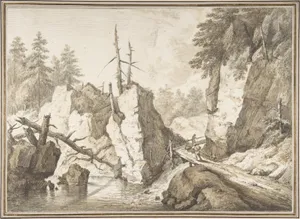
Schütz's oeuvre includes drawings and paintings that have surfaced in major collections, such as the Städel Museum in Frankfurt, and appear periodically at auction houses like Invaluable and Lempertz. Specific works are not extensively cataloged in surviving literature, but his engravings and oil pieces—often featuring European landscapes or figural studies—demonstrate a precise, observational style suited to the topographic interests of the 18th century. Platforms like Artnet document his presence in the market, with pieces attributed to him fetching interest among collectors of Northern European draughtsmanship.
Though overshadowed by contemporaries like Johann Heinrich Tischbein or the rising stars of Romanticism, Schütz's legacy endures through institutional holdings and scholarly databases, such as museum-digital:hessen. His early death in Geneva hints at possible travels or commissions abroad, preserving him as a footnote in the rich tapestry of German art history—a reminder of the many talents lost to time's selective memory. Today, his works offer a window into the understated elegance of pre-Revolutionary European provincial art.
All 1 artworks loaded