
Ctrl K
1752–1827
Friedrich Christian Klass (1752–1827) was a German landscape painter, draughtsman, and printmaker based in his native Dresden throughout his life. Born into a family of artists, he belonged to a Dresden artistic dynasty that included his brother Carl Christian Klass, a respected drawing master to the electoral pages, and his son Ludwig Friedrich Klass, who later exhibited copies after old masters at the Dresden Academy. Early in his career, Klass trained autodidactically under the supervision of Giovanni Battista Casanova while also working for a time as a theater decoration painter. From 1794 he succeeded his brother in teaching drawing to the electoral pages, instructing a number of pupils who went on to become engravers and landscape artists, among them Johann David Schubert and Carl Wilhelm Götzloff.)
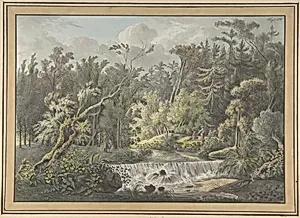
Klass specialized in river, mountain, and moonlight landscapes, producing both paintings in oil and especially admired sepia drawings and etchings. He followed the example of Joseph Roos and Christian Wilhelm Ernst Dietrich, publishing two collections of landscape etchings in 1770 and 1775 under the title *Verschiedene Landschafften*. His style bridged the decorative late-Baroque tradition and the emerging classical-idyllic approach around 1800, blending elements drawn from seventeenth-century Dutch masters with heroic and idyllic motifs; most of his compositions were studio inventions rather than direct studies from nature. Notable works include the 1775 title plate and related prints now in the Philadelphia Museum of Art and British Museum, the watercolor *Landscape with Waterfall* at the Metropolitan Museum of Art, and oil paintings such as *Der Morgen* and *Landschaft mit Wassermühle* (both 1808) in the Dresden Gemäldegalerie Alte Meister.
Klass maintained friendships with fellow artists, notably the landscape painter Johanna Marianne Freystein, who championed his work. His drawings served as models in the drawing school of the Meissen porcelain manufactory, and examples survive in major print rooms across Europe, including those in Berlin, Dresden, Vienna, and Weimar. Though only a handful of his paintings are known today, his etchings and drawings enjoyed steady appreciation in the late eighteenth and early nineteenth centuries.
Klass occupies a solid place among the capable Dresden landscape artists of his generation, bridging older Baroque conventions with the more restrained classicism that would soon dominate. His output helped sustain a vibrant local tradition of landscape printmaking and drawing that influenced both porcelain design and the next generation of Saxon artists.