
Ctrl K
995–1045
**Fujiwara no Sadayori (藤原定頼, 995–1045)** was a prominent Japanese waka poet, calligrapher, and court official of the mid-Heian period. As the eldest son of the renowned poet and scholar Fujiwara no Kintō and grandson of Emperor Murakami on his mother’s side, he grew up immersed in the refined literary and artistic traditions of the imperial court. He rose through official ranks to serve as Director of Military Affairs and later as Middle Counselor (Chūnagon), while earning fame for his elegant appearance, romantic affairs, and multifaceted talents in poetry, calligraphy, music, and even Buddhist recitation.
Sadayori excelled in waka poetry, with forty-five of his verses included in imperial anthologies. He ranks among the Late Classical Thirty-Six Immortals of Poetry (Chūko Sanjūrokkasen) and is celebrated for his contribution to the *Ogura Hyakunin Isshu*, where poem 64 evokes the misty dawn along the Uji River with its famous image of fishing stakes emerging through thinning fog. He also compiled a private poetry collection. In calligraphy, he helped shape the orthodox style of courtly kana script—graceful yet firm, with smooth, controlled strokes free of excessive flourishes—making him a foundational figure in Heian-period writing aesthetics.
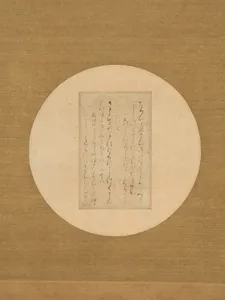
One of the most notable works traditionally attributed to him is the fragment known as the “Ōe-gire” (or Ōe Fragments), a page from a bound booklet containing two poems from the *Kokin Wakashū* on themes of palace gossip and romance. Written in ink on mica-flecked paper with gold accents and now in the Metropolitan Museum of Art collection, this piece exemplifies the refined Heian courtly hand, though scholars note it likely dates to the early twelfth century and may have been produced by a later courtier or lady.
Sadayori’s legacy endures through his poetry’s inclusion in canonical anthologies and his influence on Japanese calligraphy. As both a nobleman and artist, he embodied the Heian ideal of the cultivated courtier whose literary and calligraphic achievements continue to define classical Japanese aesthetics.