Ctrl K
1500–1500
Gakuō Zōkyū (岳翁蔵丘) was a Japanese Zen monk and painter active in the late Muromachi period, flourishing around 1482 to 1514 (with some sources extending his activity to circa 1541). His birth and death dates remain unknown, as do details of his early life and family origins, but he is closely associated with the Tōfuku-ji temple in Kyoto. Many of his surviving works bear inscriptions or praise from Ryōan Keigo (1425–1514), a high priest of Tōfuku-ji, suggesting Gakuō was a painter-monk deeply connected to this important Zen institution. He is mentioned in the 1486 diary *Shoken Niroku* by fellow Tōfuku-ji monk Kiko Taishuku, which records both his name and one of his paintings.
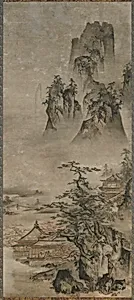
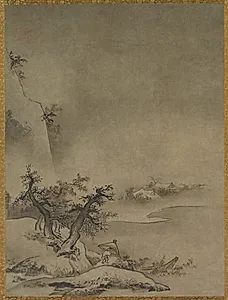
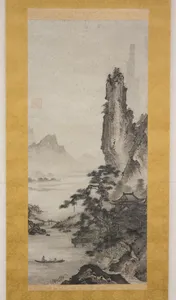
Gakuō studied under the renowned ink painter Tenshō Shūbun and worked in the Shūbun school tradition of suiboku-ga (monochrome ink wash painting). Listed as a pupil of Shūbun in contemporary records, he inherited and developed the master’s landscape style, blending the precise, Ma Yuan-inspired compositions of the Shūbun lineage with moister, more expressive brushwork reminiscent of Xia Gui. His paintings often display greater flexibility and richer, more varied ink tones than those of his teacher, while remaining faithful to Zen ideals of simplicity and contemplation. Some landscapes incorporate subtle color, an uncommon choice for the period that adds a gentle warmth to the misty mountains and streams.
Approximately twenty works by Gakuō are known today, primarily hanging-scroll landscapes. Representative examples include the *Landscape* in the Tokyo National Museum and another *Landscape* in the Masaki Art Museum. Other notable pieces are *Spring in the Mountains* (ink and light color on paper) in the Baltimore Museum of Art, *Retreat by the Water* (depicting the poet Li Bai gazing at a waterfall) in the Tokyo National Museum, and an attributed *Mountain Landscape* in the Metropolitan Museum of Art. These works typically present intimate, near-view compositions of rocky peaks, winding streams, and modest hermitages, inviting the viewer into a world of serene withdrawal.
Gakuō stands as one of the outstanding successors of Shūbun, helping to sustain and subtly evolve Muromachi ink painting during a period of transition. His landscapes, with their blend of disciplined structure and personal lyricism, embody the Zen monk-painter’s dual vocation and continue to be valued in Japanese and Western collections for their quiet spiritual depth.