
Ctrl K
1719–1826
**Georg Eisenmann** was a German artist active primarily in the 18th century, known for his landscape etchings and paintings that capture dramatic natural scenery and architectural elements. Museum records place him as active in the last third of the 18th century according to the National Gallery of Art, while the Philadelphia Museum of Art lists his lifespan as 1681–1750, aligning with an early 18th-century work dated 1703. His oeuvre focuses on evocative views of mountains, rivers, and historical sites, often incorporating figures to animate the scenes.
Little is documented about his early life, training, or artistic education. No specific teachers, mentors, or formal art school affiliations appear in available sources. He worked in the tradition of German landscape etching and drawing, producing detailed prints that emphasize atmospheric effects, such as moonlight or sunrise, alongside rugged terrain and human presence.
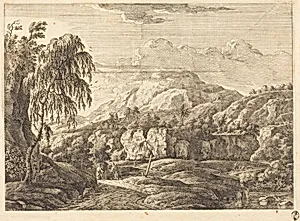
Among his notable works are *Landscape with Cross and Figures* and *Mountainous Riverscape with Figures* (both National Gallery of Art), as well as *View of the Bavarian Fort of Rothenberg around Midnight* (1703, Philadelphia Museum of Art) and *Landscape with the Rising Sun and a Rider with Attendant* (an etching). These pieces highlight his skill in rendering expansive vistas and integrating narrative elements like crosses, riders, or monastic structures. Six of his artworks are held in the Artheon Virtual Museum collection, underscoring his representation in institutional holdings.
Eisenmann’s legacy endures through his contributions to 18th-century German landscape art, preserved in major public collections including the National Gallery of Art and the Philadelphia Museum of Art. His prints and paintings continue to offer insight into the period’s fascination with nature and topography, appealing to collectors and scholars interested in the evolution of European landscape traditions.
No artworks found for this artist