Ctrl K
1705–1761
Occupations
Georg Wolfgang Knorr (1705–1761) was a German engraver, naturalist, and scientific illustrator whose meticulously detailed copper plates revolutionized the visual documentation of natural history in the eighteenth century. Born and active in Nuremberg—one of Europe's preeminent centers for scientific publishing and printmaking—Knorr combined artistic virtuosity with scientific precision, creating some of the most beautiful and influential illustrated works on botany, paleontology, and conchology of his era. His 'Thesaurus Rei Herbariae Hortensisque Universalis' has been described as the most beautiful of all flower books, while his paleontological work established him as a protogeologist who bridged the gap between Renaissance cabinets of curiosities and modern stratigraphic science. Knorr's career exemplifies the Enlightenment ideal of combining aesthetic refinement with empirical observation. Working at the intersection of art, commerce, and natural philosophy, he functioned simultaneously as engraver, illustrator, painter, collector, and art dealer. His collaboration with leading naturalists of his time resulted in lavishly illustrated folios that were as much works of art as scientific documents, elevating natural history illustration to unprecedented levels of technical sophistication and aesthetic appeal.
Georg Wolfgang Knorr was born on December 30, 1705, in Nuremberg, a free imperial city renowned throughout Europe for its thriving culture of craftsmanship, scientific instrument making, and printing. Nuremberg's long tradition of combining technical precision with artistic excellence—exemplified by Albrecht Dürer in the previous two centuries—provided an ideal environment for Knorr's development.
Knorr learned the engraving trade under the tutelage of Johann Leonard Blank, mastering the demanding techniques of copper engraving that would become the foundation of his life's work. The burin technique required not only manual dexterity but also deep understanding of how linear systems could create the illusion of form, texture, and light—skills equally applicable to artistic and scientific illustration.
His early mastery became evident with his first major success: the illustrations he created for Johannes Jacob Scheuchzer's 'Physica Sacra' (Sacred Physics, 1731), an ambitious work attempting to reconcile biblical narrative with natural history through copiously illustrated commentary. This project established Knorr's reputation for combining scientific accuracy with visual elegance.
Throughout the 1730s, 1740s, and 1750s, Knorr worked as paleontologist, painter, engraver, and art dealer in Nuremberg, which had become a scientific center attracting scholars, collectors, and publishers from across Europe. His workshop produced illustrations for numerous natural history publications while he simultaneously built his own collections of specimens and maintained an active trade in artistic prints and paintings.
His magnum opus, 'Thesaurus Rei Herbariae Hortensisque Universalis' (Universal Treasury of Garden Plants), represents the pinnacle of eighteenth-century botanical illustration. The renowned bibliographer Claus Nissen described it as 'the most beautiful of flower books,' and the praise is justified: Knorr's plates combine botanical accuracy with compositional artistry, transforming scientific documentation into aesthetic experience. Each plate demonstrates exceptional attention to detail—the translucency of petals, the texture of stems, the subtle gradations of natural color—all rendered through the challenging medium of hand-colored copper engraving.
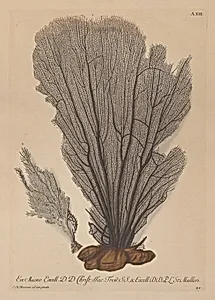
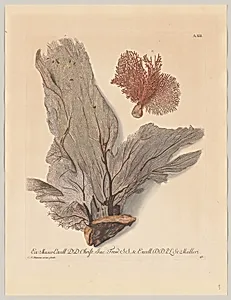
Equally significant was his work in paleontology and mineralogy. Knorr produced 'Deliciae Naturae Selectae' (Selected Delights of Nature), published posthumously in 1766–67, which documented fossils, shells, and mineral specimens with unprecedented precision. These illustrations were not merely decorative; they served genuine scientific purposes, allowing naturalists across Europe to compare specimens and discuss identifications through visual reference.
His paleontological work has earned him recognition as a protogeologist—a figure intermediate between the Renaissance collectors of 'figured stones' and the nineteenth-century geologists who would use fossils for stratigraphic identification and mapping. Knorr was among the first to systematically illustrate fossils not as curiosities but as objects worthy of scientific classification and study.
Knorr's renown ultimately rests on the detailed and accurate scientific copper plates he created and used to illustrate numerous works on natural history and paleontology, both those authored by himself and by other naturalists. His technical mastery, combined with genuine understanding of the specimens he depicted, made his illustrations indispensable references for eighteenth-century natural philosophers.
Georg Wolfgang Knorr died in his native Nuremberg on September 17, 1761, at the age of fifty-five. His posthumously published works continued to influence natural history illustration well into the nineteenth century, and his plates remain admired today as masterpieces of scientific art.
Artheon Research Team
Last updated: 2025-11-09
Biography length: ~462 words
Wikidata (CC0)