
Ctrl K
1817–1896
George Forster (1817–1896) was a German-born American painter celebrated for his meticulously detailed still-life compositions. Born in Bavaria, his early life and artistic training remain sparsely recorded in surviving accounts. He emigrated to New York around 1865 with his wife and seven children, settling first in Manhattan before moving permanently to Brooklyn, where he lived until his death. Two of his sons, Henry and George Jr., followed him into painting, and their works are sometimes confused due to similar signatures.
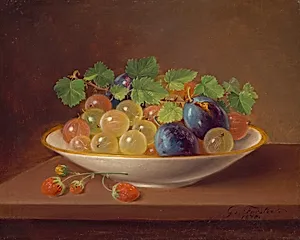
Forster worked in the tradition of 17th-century Dutch and German still-life masters, creating sumptuous, highly realistic depictions of fruit, flowers, and natural elements that emphasized texture, color nuances, and trompe-l’oeil effects such as glistening dew drops and tiny insects. He often arranged produce in outdoor or rustic settings alongside plants, birds’ nests, or small animals, and he is credited with popularizing gooseberries as a still-life motif that later artists adopted. While best known for these lush tabletop scenes, he also produced landscapes and genre pictures.
After arriving in America, Forster quickly established himself, exhibiting at the National Academy of Design, the Boston Athenaeum, the Pennsylvania Academy of the Fine Arts, the Brooklyn Art Association, and even Newhall & Co. in San Francisco. Representative works include an 1863 still life painted shortly before or around the time of his immigration and later pieces such as *Still Life with Fruit, Nuts and Fruit Flies* (1871) and *A Pail of Raspberries* (1871). His paintings now reside in collections including the Nelson-Atkins Museum of Art, the Columbus Museum of Art, and the Birmingham Museum of Art.
Forster’s legacy endures through the tactile immediacy and visual abundance of his still lifes, which continue to delight viewers and influence appreciation of 19th-century American still-life painting. Though never a household name, his technical virtuosity and contribution to the genre have secured him a lasting place in museum holdings and the art market.