Ctrl K
1698–1778
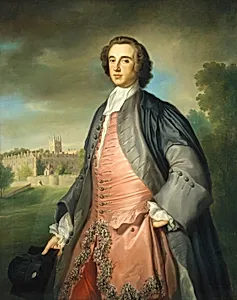
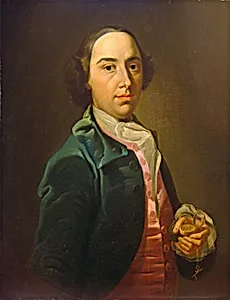
**George Knapton** (1698–1778) was an English portrait painter renowned for his work with aristocratic and royal sitters, as well as his role as a connoisseur of Old Master paintings. Born in Christchurch, Hampshire, as the son of William Knapton Esquire of Brockenhurst, he trained under the leading portraitist Jonathan Richardson and attended the St Martin’s Lane Academy in London. He later spent several years in Italy (roughly 1725–1732), where he honed his eye for classical art and even published an account of his visit to the excavations at Herculaneum in the *Philosophical Transactions* of 1740.
Knapton worked firmly within the English portrait tradition of the early-to-mid eighteenth century, producing elegant, characterful likenesses often enlivened by theatrical or “fancy” costumes. In 1736 he became a founding member of the Society of Dilettanti and served as its first official portraitist, painting numerous members—among them the Duke of Dorset, Sir Francis Dashwood, and the Earl of Holdernesse—frequently in elaborate masquerade attire. He regularly collaborated with the specialist drapery painter Joseph van Aken to render the rich fabrics and costumes that became a hallmark of his style.
Among his most significant works is the large group portrait *The Family of Frederick, Prince of Wales* (1751, Royal Collection). Other notable sitters include Admiral Sir John Norris, the Earl of Burlington, Admiral Edward Hawke, and the singer Carestini. In 1750 he was commissioned, together with George Vertue, to catalogue the royal pictures at Kensington Palace, Hampton Court, and Windsor Castle; five years later he succeeded Stephen Slaughter as Surveyor and Keeper of the King’s Pictures, a post he held until his death. He also oversaw Lord Spencer’s celebrated collection at Althorp.
Knapton died in Kensington in December 1778 and was buried there. His legacy rests on both his sensitive portraits of the Georgian elite and his pioneering curatorial work for the Crown, which helped preserve and document Britain’s royal art holdings. A younger brother, Charles Knapton, was likewise an artist and engraver.