
Ctrl K
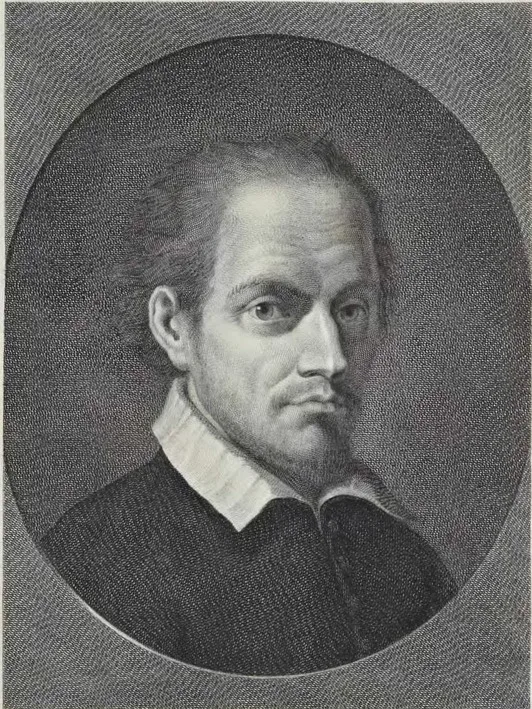
1558–1601
Giovanni Alberti, born on October 19, 1558, in Borgo San Sepolcro, emerged from a prolific family of artists that profoundly shaped his career.) The youngest son of Alberto Alberti, a versatile architect, wood-carver, painter, and Medici court artist, Giovanni was the brother of painters Alessandro (1551–1596) and Cherubino (1553–1615), with whom he frequently collaborated in the family workshop. This environment immersed him early in the techniques of decorative frescoes, fostering his specialization in quadratura—the illusionistic painting of architectural perspectives that created breathtaking spatial depth.)
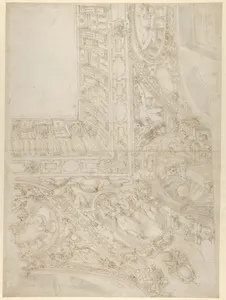
Alberti's professional ascent centered in Rome, where he contributed to prestigious Vatican projects. After February 1582, he assisted the mathematician-painter Ignazio Danti in decorating the Sala dei Palafrenieri and Sala Vecchia degli Svizzeri, adopting Danti's innovative viewer-oriented perspective. Under Pope Gregory XIII, he worked in the papal palace on Monte Cavallo and the Vatican, excelling in landscapes and architecture while his brother Cherubino supplied figures. In 1586, he joined Alessandro at Sabbioneta's Palazzo Ducale near Mantua, painting fictive colonnades in the Galleria degli Antichi, inspired by Mantegna and Correggio's illusionism.) Later commissions included the sacristy of St. John Lateran for Clement VIII and, with his brothers, the grand Sala Clementina frescoes (1595–1598), for which they earned 3,050 scudi despite Alessandro's death mid-project.
In the 1590s, Alberti and Cherubino crafted masterful frescoes in the Capella Maggiore of San Silvestro al Quirinale, featuring a trompe-l'œil oculus that drew viewers into simulated heavens.) His quadratura expertise, praised by contemporaries like Federico Zuccaro and Giovanni Baglione, extended to projects in Florence, Perugia, and his hometown, blending precise geometry with ornamental flair. A multifaceted talent, Alberti also wrote poetry and art criticism, leaving portraits in Rome's Accademia di San Luca and Florence's Uffizi.)
Dying young at 42 on August 10, 1601, in Rome, Alberti's legacy endures in the seamless integration of architecture and illusion that influenced late Renaissance and Baroque decorators. His Vatican ceilings, including a 1596–1602 Palazzo Pontifici fresco, exemplify how family synergy elevated quadratura to high art, bridging painting and architecture in eternal perspective.
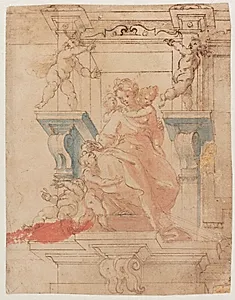
![Prudence [verso]](https://images.artheonmuseum.org/nga/thumb/prudence-verso-nga-73449.webp)