Ctrl K
Giovanni Andrea Podestà (1608–c. 1674) was a Genoese painter, draughtsman, and etcher whose career unfolded primarily in Rome, where he became known for charming scenes of putti at play. Born in Genoa, he trained in the studios of Giovanni Battista Paggi (as an apprentice by 1627, alongside Giovanni Benedetto Castiglione), Giovanni Andrea de Ferrari, and Domenico Fiasella, as recorded by the contemporary biographer Raffaele Soprani. These formative years in the vibrant Genoese Baroque milieu equipped him with a lively sense of movement and decorative flair that would later infuse his Roman works.
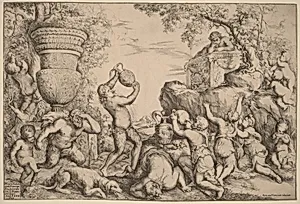
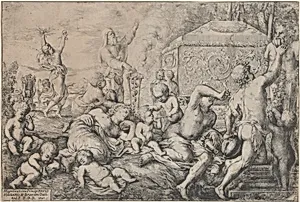
By 1634 Podestà was in Rome, where he drew after antique statues and reliefs in the celebrated Giustiniani collection; some of these studies were engraved for the *Galleria Giustiniana*. His art matured in the orbit of Nicolas Poussin, Pietro Testa, Andrea di Leone, the sculptor François Duquesnoy, and the Flemish painter Karel Philips Spierincks. Membership in the Accademia di San Luca followed in 1650. Podestà’s principal subjects—frolicking children amid classical ruins, altars, and pastoral landscapes—owe much to Poussin’s Arcadian bacchanals, themselves inspired by Titian. He produced few surviving paintings; his reputation rests largely on a series of etchings dated between 1636 and 1661, including copies after Titian’s bacchanals dedicated to influential patrons such as Cassiano dal Pozzo, Paolo Giordano Orsini II, and members of the Barberini circle.
These prints, together with a handful of drawings marked by contorted expressions, twisting figures, and dense cross-hatching reminiscent of Sinibaldo Scorza, reveal an artist of considerable charm rather than monumental ambition. Works such as *Putti as Allegory of Music*, *Drunken Silenus*, and *Landscape with a Bacchanal of Putti and a Goat* capture the lighter, more playful side of Roman classicism in the 1630s and 1640s. Although often confused with Poussin or Spierincks, Podestà’s compositions possess a distinctive, almost mischievous vitality. He later contributed to the inventory of Cardinal Mazarin’s collection and eventually returned to Genoa, where he died.
Podestà’s influence, though modest, extended to late Genoese Baroque decoration, notably the artists of the Casa Piola. His etchings after Titian helped disseminate the Venetian master’s bacchanalian themes, while his own putti scenes offered a decorative counterpoint to the more austere classicism of his Roman contemporaries. Today he is valued as a minor yet engaging figure whose work illuminates the international, antiquarian culture of seventeenth-century Rome.
All 2 artworks loaded