Ctrl K
1855
Gladys C. Parker was an American artist active around 1935 whose precise watercolor renderings form a distinctive part of the Index of American Design. Early life is not well documented, and no records of formal training, teachers, or family background have come to light. She is known solely through the eleven works she produced for this ambitious New Deal initiative, all now held by the National Gallery of Art.
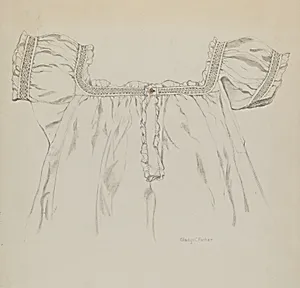
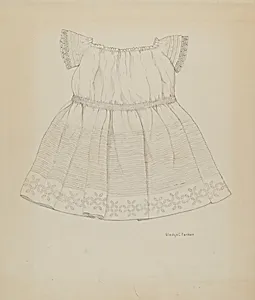
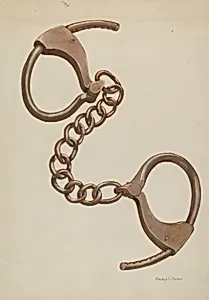
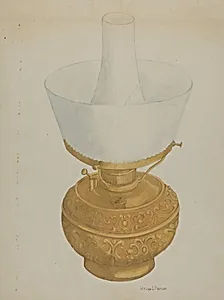
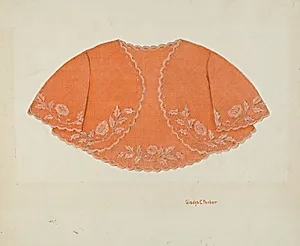
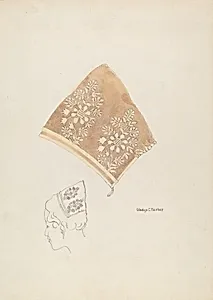
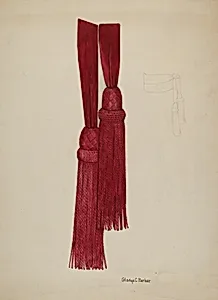
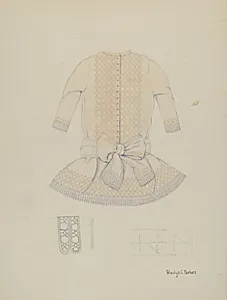
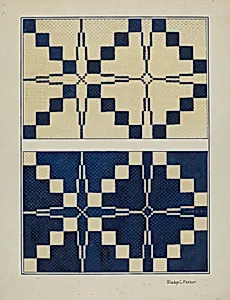
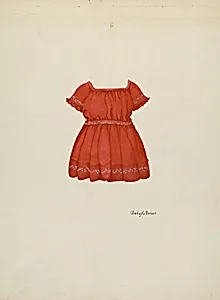
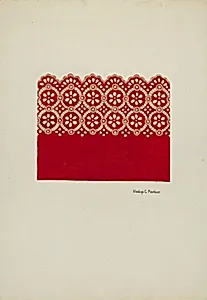
The Index of American Design, launched in 1935 as a division of the Federal Art Project under the Works Progress Administration, employed hundreds of artists to create a comprehensive pictorial survey of American decorative arts, folk crafts, and material culture from the colonial era to 1900. Parker’s contributions focused on textiles and historic garments. Among her documented pieces are several Child’s Dress studies (c. 1936–1937), a Lace Cap (c. 1937), Embroidery for Dress (c. 1936), Woven Bedspread (c. 1936), Civil War Sash (c. 1936), Chemise (c. 1937), Child’s Cape (c. 1937), Shackles or Leg Irons (c. 1937), and a Lamp (c. 1937). Executed in watercolor, graphite, and gouache on paper, these drawings capture intricate patterns, textures, and construction details with scientific accuracy rather than personal flourish.
Parker worked in the documentary tradition of the Index, whose goal was to identify and preserve a uniquely American aesthetic while providing employment during the Great Depression. Her renderings emphasize fidelity to the original objects—lace motifs, woven structures, embroidered florals, and even utilitarian items such as shackles—serving as both historical record and potential inspiration for contemporary designers. The project as a whole generated more than 18,000 such drawings by roughly 400 artists across 34 states.
Although Parker herself remains an elusive figure, her eleven plates endure as part of one of the most complete visual archives of American design ever assembled. They continue to be studied by historians, conservators, and artists interested in the nation’s craft heritage, quietly illustrating how government-sponsored documentation during the 1930s helped define and celebrate everyday American creativity.