
Ctrl K
1615–1673
Gong Dingzi (1615–1673), courtesy name Xiaosheng and literary name Zhilu, was a distinguished Chinese poet, calligrapher, and high-ranking official from Hefei in Anhui Province, with ancestral roots in Linchuan, Jiangxi. A precocious talent skilled in the eight-legged essay form required for imperial examinations, he earned his jinshi degree in 1634 at the remarkably young age of nineteen. He first served as magistrate of Qishui County in Hubei, where he successfully defended the city against rebel forces for seven years, earning the gratitude of local residents who later built a shrine in his honor. In 1641 he was posted to Beijing as a supervising secretary in the Ministry of War, where his outspoken memorials criticizing ministers and policies led to his imprisonment by the Chongzhen Emperor; he was released in early 1644. During this period he met and took as his concubine the celebrated Qinhuai courtesan and painter Gu Mei, with whom he shared a lifelong artistic partnership.
Navigating the turbulent Ming-Qing transition, Gong served the fallen Ming, briefly under Li Zicheng’s Dashun regime, and then the Qing dynasty, ultimately rising to Minister of Rites and Minister of Punishments. Despite political controversies surrounding his successive allegiances, he remained a central figure in Jiangnan literary circles. Together with Qian Qianyi and Wu Weiye, he formed the celebrated Three Masters of Jiangdong, a group renowned for revitalizing the ci lyric form of classical Chinese poetry during an era of dynastic upheaval. His collected works, including the Dingshan Tang wenji and Dingshan Tang shiji, preserve a substantial body of verse that reflects both personal emotion and historical reflection.
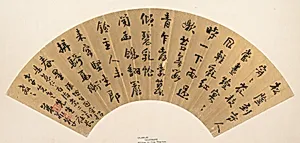
As a literati artist, Gong excelled in calligraphy, working firmly within the late-Ming tiexue (model-book) tradition that took the Two Wangs—Wang Xizhi and Wang Xianzhi—as its orthodox foundation, while absorbing the elegant influences of Dong Qichang and Zhao Mengfu. His brushwork is vigorous and unrestrained yet refined, with solid, rounded strokes, well-proportioned characters, and an air of scholarly grace that overcame the period’s tendency toward weakness. He also painted landscapes, though calligraphy remained his strongest visual medium. Surviving works include running-script hanging scrolls of his own poems and a folding-fan calligraphy now in the Metropolitan Museum of Art, executed in ink on gold paper. His wife Gu Mei specialized in orchid paintings in the manner of Zhao Mengfu, and the couple frequently collaborated, with Gong adding poetic inscriptions to her pictures.
Gong’s legacy endures both as a poet who helped define the literary voice of the Ming-Qing transition and as a calligrapher whose works are preserved in major collections. Generous toward fellow scholars, he used his influence to aid imprisoned friends such as Fu Shan and Yan Ermei and to advance younger talents. He died in 1673, leaving behind a reputation as one of the era’s most versatile and resilient cultural figures.