Ctrl K
1903–1980
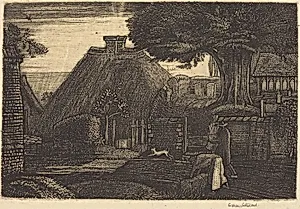
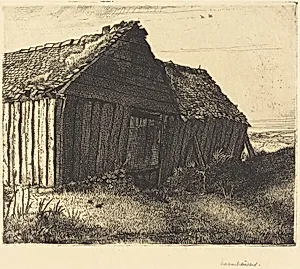
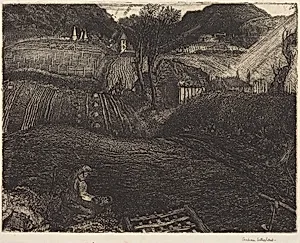
Graham Sutherland (1903–1980) was one of the most significant British painters of the twentieth century, whose intensely personal vision fused a deep feeling for landscape with a sense of organic menace that placed him at the forefront of British Neo-Romanticism. He studied at the Goldsmiths College of Art in London during the early 1920s, training initially as an engraver and etcher in a tradition that nurtured his keen eye for line and texture. The landscapes of Pembrokeshire in Wales, which he first visited in the 1930s, proved a decisive revelation, offering him a world of twisted roots, eroded forms, and ancient light that would fuel his imagination for decades.
Sutherland's wartime service as an official British war artist brought him international attention, as his paintings of bomb-damaged streets, steel foundries, and tin mines conveyed the terror and sublimity of industrial destruction with an almost visionary intensity. After the war, he increasingly explored religious and symbolic themes, culminating in his monumental tapestry Christ in Glory in the Tetramorph, woven for the new Coventry Cathedral and unveiled in 1962. At roughly twenty-four meters tall, it remains one of the most ambitious works of religious art produced in twentieth-century Britain.
Sutherland was also one of the most sought-after portrait painters of his era, producing penetrating likenesses of figures including Somerset Maugham, Lord Beaverbrook, and Winston Churchill. His portrait of Churchill, commissioned by Parliament in 1954, became famous in part because Churchill reportedly disliked it so strongly that it was eventually destroyed — an episode that paradoxically enhanced the painting's legend.
His legacy encompasses a rare breadth: landscape, abstraction, religious imagery, and portraiture all informed by an intensely private symbolism. Sutherland's ability to locate the uncanny within the natural world gave British art a distinctive and enduring voice in the mid-twentieth century international conversation.
All 3 artworks loaded