
Ctrl K
1644–1730
Movements
Occupations
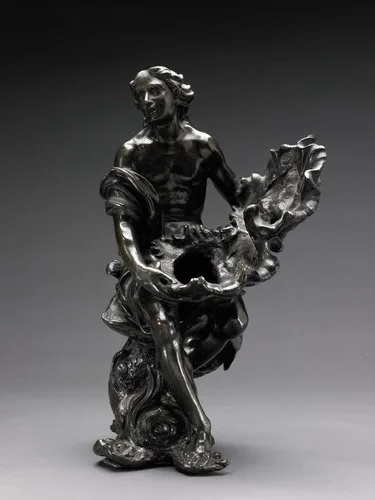
Gabriël Grupello (1644-1730) was a Flemish Baroque sculptor whose career spanned the Netherlands, France, and Germany, creating religious and mythological sculptures, portraits, and monumental public works that exemplified the dramatic energy and technical virtuosity of Baroque art. Born in Geraardsbergen in the Spanish Netherlands to an Italian father and Flemish mother, Grupello received training under Artus Quellinus the Elder, one of the leading Baroque sculptors, before establishing an international practice that brought him appointments as court sculptor to both Charles II of Spain and Elector Johann Wilhelm of the Palatinate. Grupello distinguished himself among his Flemish contemporaries through his rare mastery of bronze casting in addition to traditional work in marble, ivory, and wood. His technical range allowed him to execute everything from intimate cabinet pieces in ivory to monumental bronze equestrian statues. His most famous work, the bronze equestrian statue of Elector Johann Wilhelm in Düsseldorf, demonstrates his ability to combine Baroque dynamism with classical compositional principles at a scale that dominated urban space and embodied princely power.
Gabriël Grupello (also known as Gabriël de Grupello or Gabriël Reppeli) was born on May 22, 1644, in Geraardsbergen in the Spanish Netherlands (present-day Belgium). He was the son of Bernardo Rupelli, an Italian cavalry captain in Spanish military service, and his Flemish wife Cornelia Delinck, making Grupello a product of the cosmopolitan military and cultural environment of the Spanish Habsburg Netherlands.
At age fourteen, in 1658, Grupello began a five-year apprenticeship in the Antwerp workshop of Artus Quellinus the Elder, the most celebrated Flemish sculptor of the Baroque era. Quellinus had established his reputation through his sculptural program for Amsterdam's new town hall (now the Royal Palace), a project that required managing numerous assistants and executing sculptures at multiple scales.
Under Quellinus's tutelage, Grupello learned not only technical skills in modeling, carving, and casting but also the organizational abilities necessary for managing large sculptural projects. He absorbed the Baroque style's characteristic dynamism, dramatic poses, flowing drapery, and emotional expressiveness while mastering the full range of sculptural materials.
In 1673, Grupello became a master in the guild of the Vier Gekroonde ('the Four Crowned Heads') in Brussels, achieving the professional recognition that allowed him to accept independent commissions and establish his own workshop. This guild membership marked his transition from apprentice and journeyman to independent master sculptor.
In February 1688, Grupello's growing reputation earned him appointment as court sculptor to Charles II of Spain, the last Habsburg king of Spain. This prestigious position provided steady income, access to aristocratic patrons, and the prestige associated with royal service.
As court sculptor, Grupello would have been responsible for creating sculptures for royal palaces, commemorative works celebrating the dynasty, religious sculptures for royal chapels, and portrait busts of the king and royal family. Such positions typically involved both creative work and administrative responsibilities managing workshops and coordinating with architects.
His appointment to the Spanish court demonstrated his international reputation and the continued prestige of Flemish sculptors, who had established dominance in Baroque sculpture through figures like Quellinus, François Duquesnoy, and others.
The Spanish Habsburg court, though in political and economic decline by the late seventeenth century, maintained elaborate cultural patronage and sophisticated artistic programs. Grupello's work for Charles II connected him to one of Europe's ancient royal dynasties during its final generation.
In 1695, Grupello received an even more significant appointment when Elector Johann Wilhelm of the Palatinate appointed him as official court sculptor. Grupello subsequently moved to Düsseldorf, the Elector's capital, where he would spend the next three decades creating his most important works.
Johann Wilhelm (known as Jan Wellem in local dialect) was an enthusiastic art patron who transformed Düsseldorf into a significant cultural center. He assembled an important painting collection and commissioned ambitious architectural and sculptural projects that enhanced his capital's prestige.
For Elector Johann Wilhelm, Grupello created his masterpiece: a bronze equestrian statue of the Elector himself. This monumental work, executed in bronze, demonstrated Grupello's rare mastery of large-scale bronze casting—a technically demanding process that relatively few Flemish sculptors of his era had mastered.
The equestrian statue represented the culmination of a tradition extending back through Bernini's lost equestrian statue of Louis XIV to Renaissance examples by Giambologna and Leonardo. Grupello successfully balanced Baroque dynamism with classical restraint, creating a work that embodied princely authority and artistic sophistication. He executed works in marble, ivory, and wood alongside his bronze castings, demonstrating complete technical versatility. His religious sculptures for churches, mythological works for palaces, and portrait busts of courtiers and nobles established his position as one of the foremost sculptors working in Germany during the late Baroque period.
In 1719, the Holy Roman Emperor Charles VI appointed Grupello as Imperial sculptor, adding yet another prestigious title to his accumulated honors. This appointment recognized both his artistic achievements and his service to Habsburg interests through his work for Johann Wilhelm.
By the 1720s, Grupello had reached old age and gradually reduced his sculptural production. In 1725, at age eighty-one, he and his wife moved from Düsseldorf to Kerkrade (now in the Netherlands), where they lived in quarters at Ehrenstein Castle with their daughter and her husband, an imperial official.
This retirement arrangement was typical for successful artists whose children had married into the administrative or aristocratic classes. It provided Grupello with comfortable circumstances for his final years while maintaining the family connection across generations.
Gabriël Grupello died at Ehrenstein Castle in Kerkrade on June 20, 1730, at the remarkable age of eighty-six. He had lived through and contributed to nearly the entire Baroque period, working for Spanish Habsburg and Palatine courts, mastering multiple materials and scales, and creating works that embodied the dramatic energy and technical virtuosity characteristic of Baroque art at its height.
Artheon Research Team
Last updated: 2025-11-09
Biography length: ~491 words
Wikidata (CC0); Getty ULAN (ODC-By)
