
Ctrl K
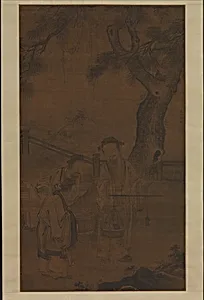
1456–1532
**Guo Xu (1456–1532)** was a Chinese painter active during the Ming dynasty, known for his work in ink and color on silk and paper. Born in Taohe, Jiangsu province, he served as a court painter during the Hongzhi emperor’s reign (1488–1506). His career placed him within the vibrant artistic circles of the late fifteenth and early sixteenth centuries, where he produced both intimate album leaves and larger hanging scrolls.
Guo Xu maintained a close friendship with the renowned literati master Shen Zhou (1427–1509), a leading figure of the Wu school tradition centered in Suzhou. While no formal teacher is documented, this association connected him to the scholarly painting circles that emphasized personal expression, poetry, and references to earlier masters. His style often blended delicate figure painting with landscape elements, reflecting both courtly refinement and literati interests in historical and Daoist themes.
Among his notable works is an album dated 1503 featuring legendary figures such as Shennong and Fuxi, now preserved in museum collections. Other important pieces include the hanging scroll *Weighing Books* (early 16th century) at the Metropolitan Museum of Art, *Country Living*, and *Landscape and Fisherman with Poem* at the Detroit Institute of Arts. These demonstrate his skill in narrative scenes and atmospheric landscapes.
Guo Xu’s legacy endures through his surviving paintings in major institutions worldwide, including the Met, the Detroit Institute of Arts, and private collections. His contributions to Ming figure and landscape painting continue to be studied for their blend of courtly and scholarly aesthetics, offering insight into the artistic networks of his era.