Ctrl K
1786–1835
Gustav Heinrich Naeke (1786–1835) was a German history painter, portraitist, and draughtsman whose career bridged the academies of Dresden and the vibrant community of German artists in Rome. Born in Frauenstein, Saxony, he trained at the Dresden Academy, where he studied under the neoclassical painter Friedrich Heinrich Füger and later came under the influence of Ferdinand Hartmann, a professor there from 1810. These formative years instilled in him a rigorous approach to figure drawing and historical subjects that would define his output.
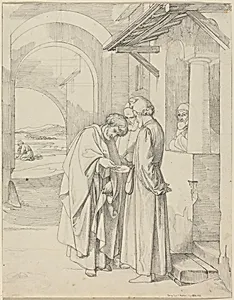
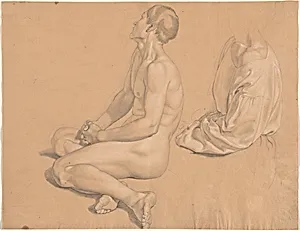
In 1817 Naeke traveled to Rome, joining the circle of German-speaking artists who gathered there in the early nineteenth century. He remained for several years, forming close friendships with Joseph Anton Koch and Heinrich Olivier while immersing himself in the city’s classical and Renaissance heritage. During this period he produced large-format history paintings and numerous studies, including the biblical scene of Peter Paying the Temple Tax (1820–1821). His drawings of Roman architecture and figure studies reveal a precise, observant hand attuned to both monumental subjects and intimate portraiture.
Returning to Dresden, Naeke established himself as a respected professor at the Academy, where he taught drawing and painting while continuing to exhibit and create works that blended academic discipline with the emerging Romantic interest in narrative and emotion. Though his life was relatively short, his contributions as both practitioner and educator helped sustain the tradition of history painting in Saxony. Today his paintings and drawings are held in collections such as the Städel Museum and the National Gallery of Art, preserving his place among the lesser-known yet influential figures of early-nineteenth-century German art.