
Ctrl K
1348–1420
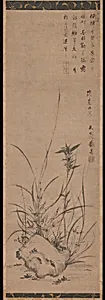
**Gyokuen Bonpō (1348–after 1420)** was a prominent Japanese Zen Buddhist monk, abbot, calligrapher, and literati painter of the early Muromachi period. He is best known for his delicate monochrome ink paintings of orchids, bamboo, and rocks, which blended Chinese scholarly traditions with Japanese Zen aesthetics.
As a high-ranking priest, Bonpō served as abbot of major Kyoto temples including Kennin-ji and Nanzen-ji, and earlier postings took him to Manju-ji in Bungo and initially to Kamakura. He studied Chinese ink painting practices and drew particular inspiration from the 14th-century Chinese monk-painter Pu Ming (P’ou-ming), adapting the latter’s elegant depictions of orchids into his own distinctive style. Working primarily in *suiboku* (ink wash) on paper or Korean paper, he favored intimate, close-up compositions of supple orchid leaves, fragile blossoms, and textured rocks, often combining these with semicursive calligraphy that unified image and inscription.
His surviving works, created mainly in the late 14th and early 15th centuries, include *Orchids and Rock* (Metropolitan Museum of Art), *Orchids and Bamboo* (National Museum of Asian Art), and paired screens such as *Orchids, Bamboo, and Brambles* (Minneapolis Institute of Art and Brooklyn Museum). These pieces exemplify the Muromachi-era fusion of Zen spirituality, Chinese literati culture, and poetic sensibility, moving beyond large landscapes to celebrate the quiet beauty of plants and rocks.
Bonpō’s legacy lies in his role as one of the great literati monk-painters of his time. Steeped in Chinese poetry and painting, he helped shape the refined, ink-based aesthetic that would influence later Japanese artists. Though he painted as an avocation alongside his monastic duties, his distinctive orchid imagery remains a hallmark of early Muromachi Zen art.