
Ctrl K
1894–1967
Hans Otto Orlowski (1894–1967) was a German woodcut artist and painter born in Insterburg, East Prussia, to a master tailor father. His family relocated during his childhood to Königsberg, Potsdam, and finally Charlottenburg near Berlin. Orlowski studied from 1911 to 1915 at the Kunstgewerbe- und Handwerkerschule in Charlottenburg under Harold Bengen, specializing in linocuts; his training was interrupted by World War I service in Serbia, where he was wounded, and subsequent work as a draftsman in the War Ministry, during which he produced his first linocuts in 1915 and woodcuts in 1916. He resumed studies in 1918–1919 at the Staatliche Kunstschule Berlin under Philipp Franck, graduating in 1919, and joined the Berlin Secession that year.
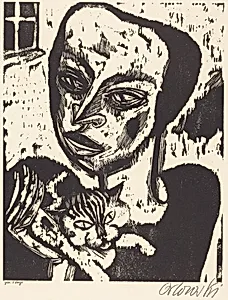
Appointed professor in 1931, Orlowski taught at the Kunstgewerbeschule Charlottenburg from 1921 or 1922 until 1945, influencing generations of artists, then led a class in murals and stained glass at the Berlin University of the Arts from 1945. Initially aligned with Expressionism, he rejected it after a 1924 Paris trip, destroying over sixty paintings from 1920–1924 and developing a distinctive style of powerful, sweeping lines in woodcuts that defied easy classification. Seven early works, including *Wanderer* (1925) and *Mädchen mit Katze* (1920), were confiscated as "degenerate art" in 1937, though he continued exhibiting. World War II brought devastation: his workshop was bombed, erasing woodblocks and sixty-five paintings, and his apartment destroyed in 1945.
Orlowski's oeuvre features dynamic woodcuts like *Man in a Storm* (1947), *The Lookout* (1946), and post-war series including *Nike and the Shepherd Boy*, *Hope*, and *Weighing Angel* (all 1946), held in collections such as the National Gallery of Art (fourteen works). He illustrated livres d'artiste for Goethe's *Nature* (1932), Dostoevsky's *Grand Inquisitor* (1953), and Schiller's *Kassandra* (1959), among others. His first solo exhibition came in 1934 at Galerie Gurlitt, Berlin, followed by shows in Leipzig, The Hague, Munich, Linz, Würzburg, Ljubljana, and Tokyo into the 1950s and 1964.
Orlowski's legacy endures through his pedagogical impact—he taught figures like Toni Mau and Rudolf Bredow—and awards including the 1954 Berlin Art Prize and 1963 East Prussian Cultural Prize. Part of the "lost generation" of expressive realists, his resilient post-war woodcuts capture human drama with mythic intensity, securing his place in twentieth-century German graphic art.