Ctrl K
1839–1924
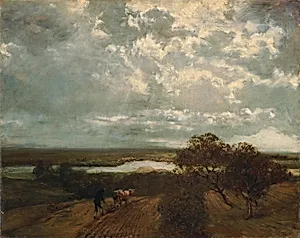
Hans Thoma (1839-1924) was a distinguished German painter often celebrated as the "Painter of the Black Forest" for his deep connection to the landscapes and folklore of his native region in southwestern Germany. Born to a miller's family in the Black Forest village of Bernau, Thoma rose from humble origins to become one of Germany's most respected artists and eventually director of the prestigious Karlsruhe Kunsthalle. Throughout his long career, Thoma developed a distinctive style that synthesized influences from French Realism, particularly Gustave Courbet whom he met in Paris, with German Romantic sensibilities and an appreciation for Italian Renaissance art. His work evolved from the meticulous naturalism of his early landscapes to embrace Symbolism by the century's end, making him a bridge between traditional academic art and modern European movements. His artistic output was remarkably diverse, encompassing not only landscape paintings but also mythological scenes, portraits, and decorative arts including pottery and furniture design.
Hans Thoma was born on October 2, 1839, in Bernau, a small village in the Black Forest region of the Grand Duchy of Baden, Germany. He came from modest circumstances as the son of a miller, an upbringing that instilled in him a lifelong connection to the rural landscapes and folk traditions of his homeland.
His earliest artistic training came from an unlikely source: a painter of clock faces who taught him the basics of painting technique. This humble beginning in the decorative arts would later influence Thoma's willingness to work across various media, including applied arts.
In 1859, at age twenty, Thoma entered the Karlsruhe Academy, where he studied under Johann Wilhelm Schirmer, a landscape painter, and Ludwig Des Coudres, a professor of drawing. This formal academic training provided him with classical techniques while he maintained his personal connection to the naturalistic observation of his native Black Forest.
In 1866, Thoma advanced his studies by entering the prestigious Düsseldorf Akademie, where he was introduced to contemporary artistic developments and modern French art. The Düsseldorf school was known for its emphasis on detailed naturalism and dramatic compositions.
Two years later, in 1868, Thoma traveled to Paris, a journey that proved transformative for his artistic development. In the French capital, he encountered the work of Gustave Courbet, the leading figure of French Realism. The meeting between Thoma and Courbet was significant; Courbet's emphasis on painting directly from nature and his rejection of idealized academic subjects resonated deeply with Thoma's own sensibilities.
The influence of Courbet can be seen in Thoma's adoption of more vigorous brushwork and his commitment to depicting the observable world with honesty and directness, while maintaining the poetic sensibility characteristic of German Romanticism.
From 1876 to 1899, Thoma lived and worked in Frankfurt am Main, a period that proved crucial for his artistic maturity and commercial success. During these years, he made contact with avant-garde artistic circles while gradually achieving recognition and financial stability.
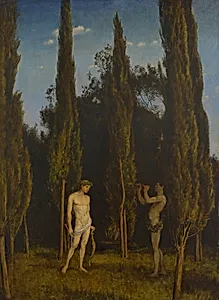
In Frankfurt, Thoma's work evolved to incorporate Symbolist elements alongside his landscape paintings. He began creating mythological and allegorical subjects that reflected the pan-European Symbolist movement's interest in spiritual and psychological themes.
His connection to Italian Renaissance art, cultivated through travels to Florence and other Italian cities, became increasingly evident in his work during this period. Like the "German Romans" before him, Thoma found in Renaissance art a means of contemporary expression that contributed to the genesis of European Symbolism at the century's end.
During the Frankfurt years, Thoma also expanded his practice beyond painting to include decorative arts, designing pottery, furniture, and other applied art objects, demonstrating the breadth of his creative vision.
In 1899, Thoma's achievements were recognized when he was appointed director of the Kunsthalle Karlsruhe, the art museum where he had once been a student. This prestigious position marked the culmination of his career and affirmed his status as one of Germany's leading artists.
The ultimate honor came in 1909 when a Hans Thoma Museum was opened within the Karlsruhe Kunsthalle during his lifetime—an extraordinary recognition rarely bestowed upon living artists. This museum was dedicated to preserving and exhibiting his extensive body of work.
As director, Thoma influenced museum policy and acquisitions while continuing his own artistic production. His late works often returned to the themes of his youth: the forests, valleys, and mountain landscapes of his beloved Black Forest, painted with the accumulated wisdom of decades of practice.
Hans Thoma died on November 7, 1924, in Karlsruhe, leaving behind a vast artistic legacy that included hundreds of paintings, drawings, and decorative works that captured the essence of German landscape and the evolution of European art from Realism through Symbolism.
Artheon Research Team
Last updated: 2025-11-09
Biography length: ~487 words