Ctrl K
1660–1740
Occupations
Jacobus Harrewijn (1660-1727) was a Flemish engraver whose topographical prints documented cities, castles, and abbeys throughout the Low Countries during a period of significant political and cultural transformation. Born in Amsterdam and baptized on September 15, 1660, Harrewijn trained under the renowned printmaker Romeyn de Hooghe before establishing himself in the Southern Netherlands. His career spanned multiple cities—he joined the Antwerp Guild in 1688, worked extensively in Brussels from 1695 to 1714, and later practiced in The Hague. A prolific engraver and etcher, Harrewijn specialized in detailed architectural views that served both documentary and decorative purposes, creating visual records of religious institutions, fortifications, and urban landscapes. His personal life proved as eventful as his professional career, with fifteen children born to his second wife Anne-Catharina van Cleemput. Harrewijn's prints remain valuable historical documents, preserving images of buildings and urban spaces as they appeared in the late seventeenth and early eighteenth centuries.
Jacobus Harrewijn was baptized on September 15, 1660, in Amsterdam, entering a world where printmaking served crucial functions in disseminating images, recording topography, and decorating bourgeois homes. He received his artistic training under Romeyn de Hooghe (1645-1708), one of the period's most accomplished and versatile printmakers. De Hooghe's workshop provided instruction in etching and engraving techniques, compositional principles, and the various genres of printmaking from political satire to topographical documentation.
In 1682, Harrewijn married in Amsterdam, establishing his first household. However, his career trajectory would soon lead him southward to the Southern Netherlands (roughly corresponding to modern Belgium), where greater opportunities beckoned.
In 1688, Harrewijn joined the Guild of Saint Luke in Antwerp, the professional organization regulating artists and craftsmen in that city. This affiliation established his professional credentials in the Southern Netherlands and connected him to networks of patrons, publishers, and fellow artists.
The following year, 1689, brought personal change: Harrewijn remarried in Deurne (near Antwerp) to Anne-Catharina van Cleemput on July 20. This marriage proved remarkably fruitful—the couple had fifteen children, suggesting a household constantly bustling with activity alongside Harrewijn's professional production.
From 1695 to 1714, Harrewijn worked primarily in Brussels, the capital of the Spanish Netherlands (later Austrian Netherlands after 1714). During these nearly two decades, he created numerous topographical prints documenting the city's architecture, religious institutions, and urban spaces. His work served multiple purposes: providing decorative prints for collectors, creating documentary records for historical purposes, and illustrating published works describing the region's notable sites.
Later sources indicate Harrewijn worked in The Hague, though the precise dates remain uncertain. Some records suggest activity from 1727 to 1732, though this contradicts his burial record of June 10, 1727, in Brussels. The discrepancy may reflect confusion with other artists or posthumous circulation of his prints.
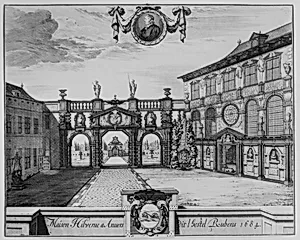
Harrewijn's work encompassed detailed engravings and etchings of castles, abbeys, city views, and historical sites throughout the Low Countries. His prints of Brussels, Antwerp, Gembloux, and numerous religious foundations preserve valuable visual information about baroque architecture and urban planning before later alterations and destructions.
Artheon Research Team
Last updated: 2025-11-09
Biography length: ~442 words
Wikidata (CC0); Getty ULAN (ODC-By)