Ctrl K
1892–1968
Harry Herman Wickey, born in 1892 in Stryker, Ohio, emerged from humble rural roots as the descendant of pioneers and farmers, taking on jobs as a farmhand, laundry operator, and grocer before pursuing art. He studied at the Detroit School of Fine Arts and later attended classes at New York's Ferrer Modern School in 1915, where he drew encouragement from artists George Bellows and Robert Henri. Around this time, he studied under illustrator Harvey Dunn and met sculptor Mahonri M. Young, who provided ongoing support during challenging periods. Drafted into World War I in 1917 and stationed in France, Wickey returned to New York, establishing a studio and diving into drypoint and etching by 1920.
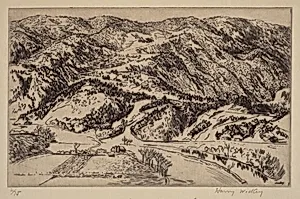
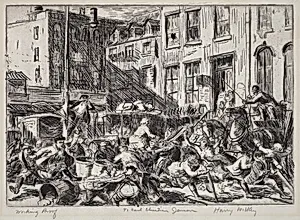
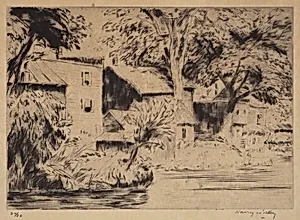
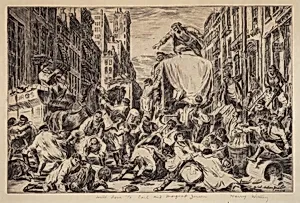
Wickey's early fame rested on his masterful etchings and drypoints capturing everyday American scenes with a keen eye for light, texture, and human struggle—urban laborers, rural cabins, and dramatic landscapes. Notable works include *Woman Hanging Clothes* (1921), *Negro Cabin* (1921), *Ninth Avenue* (1925), *Midsummer's Night* (1922/1926, awarded the Logan Medal), and *Storm Sweeping the Hudson* (1934, recipient of the Noyes Prize). In 1938, impaired eyesight from etching acids prompted a pivot to sculpture and lithography, yielding powerful bronzes like *The Old Wrestler*, *Wrestlers #2* (1929), and *Stallion and Mare* (1936), as well as prints such as *Woods Scene* and *Storm King in Winter* (1933). His realist style, blending gritty realism with poetic atmosphere, resonated with the era's focus on American life.
A dedicated teacher at the Art Students League of New York, Wickey influenced generations of artists, while his wife, Maria Rother Wickey (1897–1955), a fellow painter and printmaker who studied at the National Academy of Design and co-founded the Whitney Studio Club, shared his creative world. Elected to the National Academy of Design and active in the Woodstock Art Association, he exhibited widely at venues like the Art Institute of Chicago, Guggenheim, Pennsylvania Academy of the Fine Arts, and Whitney Museum. Wickey's autobiography, *Thus Far*, chronicles his journey, and his works endure in collections including the National Gallery of Art, Smithsonian American Art Museum, and Whitney—testaments to a life bridging printmaking prowess with sculptural vitality.
All 4 artworks loaded