
Ctrl K
1440–1514
**Michael Wolgemut, Wilhelm Pleydenwurff, Hartmann Schedel, and Anton Koberger: The Nuremberg Collaborative**
In the vibrant artistic hub of late-15th-century Nuremberg, Michael Wolgemut (1434–1519), Wilhelm Pleydenwurff (c. 1460–1494), Hartmann Schedel (1440–1514), and Anton Koberger (c. 1445–1513) formed a powerhouse team whose collaboration produced one of the era's crowning achievements: the *Nuremberg Chronicle* (*Liber Chronicarum*, 1493). Wolgemut, a leading painter and printmaker, trained under his father, Valentin Wolgemut, and served as assistant to Hans Pleydenwurff before marrying the latter's widow in 1472, making Wilhelm—Hans's son—his stepson and workshop partner from 1491. Schedel, a Nuremberg-born physician, humanist, and cartographer with a tutor in Matheolus Perusinus, authored the text, while goldsmith-turned-printer Koberger, who established Nuremberg's first press in 1470, handled publication.
Wolgemut's expansive Nuremberg workshop embodied the Northern Renaissance spirit, blending Flemish influences evident in his paintings—such as the 1479 high altar retable for St. Mary's Church in Zwickau—with innovative woodcuts that introduced volume, shading, and vigorous forms adapted masterfully to the medium. His pupils included the young Albrecht Dürer (apprenticed 1486–1489), who likely contributed to early designs. Wilhelm, considered by some a finer artist, collaborated closely on prints across media. This atelier produced altar pieces like the Augustinian friars' retable (now in a Nuremberg museum) and decorations for Goslar's town hall (1501), working in the Nuremberg tradition of richly gilded, high-relief wood sculptures and hand-colored illustrations.
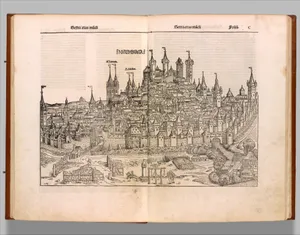
Their magnum opus, the *Nuremberg Chronicle*, a 336-page universal history from Creation to the late 15th century, featured 1,809 woodcuts from 645 blocks—many reused—depicting biblical scenes, mythical creatures, and pioneering city views like double-page spreads of Nuremberg and Constantinople. Commissioned by patricians Sebald Schreyer and Sebastian Kammermeister, it appeared in Latin (c. 1,400–1,500 copies) and German editions, printed on Koberger's twenty-four presses.
This incunabulum revolutionized illustrated printing, integrating text and image seamlessly and setting standards for encyclopedic works. Its legacy endures in art history as a pinnacle of German woodcut artistry, bridging medieval chronicles and Renaissance humanism, while Wolgemut's tutelage propelled Dürer to eclipse his master. (312 words)