
Ctrl K
1677–1677
Heinrich Werdmüller stands as one of the most elusive figures in Swiss art history, a draughtsman active in the early 17th century whose life remains sparsely documented. Recorded as a Swiss artist who possibly died in Zurich in 1677, Werdmüller's career spanned roughly from 1600 to 1677, placing him amid the vibrant artistic currents of the Baroque era in Central Europe. Little is known of his early life, training, or mentors—no records surface of formal apprenticeships under notable masters or affiliations with specific academies, leaving his formative years shrouded in obscurity. This paucity of biographical detail underscores the challenges of tracing minor artists from Zurich's provincial scene, where many worked outside major courts or guilds.
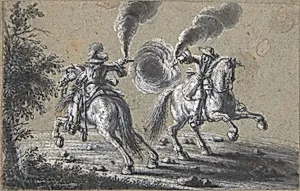
Werdmüller's sole surviving work, *Two Horsemen Shooting at Each Other* (ca. 1600–1677), exemplifies his skill in capturing dramatic tension through economical means. Executed in pen and black ink with brush and gray wash heightened by gouache on a modest sheet measuring just 2 7/8 x 4 1/2 inches (7.3 x 11.4 cm), the drawing depicts two mounted figures charging toward one another, pistols blazing in a visceral duel. The composition pulses with motion—the rearing horses, swirling cloaks, and billowing smoke evoke the theatrical energy of Baroque battle scenes, akin to influences from Flemish or Italian equestrian sketches, though Werdmüller adapted them to a Swiss context of restrained intensity. Housed today in The Metropolitan Museum of Art, this piece highlights his mastery of line and wash to convey raw conflict and immediacy.
Though no other works or patrons are definitively linked to Werdmüller, his drawing endures as a testament to the unsung talents of 17th-century Swiss graphic artists, who often prioritized functional sketches over grand oil paintings. Preserved through institutional acquisition in 2007, it offers a glimpse into an era when such dynamic studies might have served as models for engravers or tapestry designers. Werdmüller's legacy, though faint, enriches our understanding of Zurich's understated contributions to European draftsmanship, reminding us that even fleeting lives can yield enduring visual poetry.
No artworks found for this artist