Ctrl K
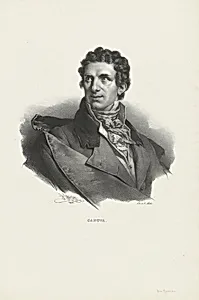
1776–1860
Pierre-Louis Henri Grévedon (1776-1860) was a French painter, miniaturist, engraver, and lithographer whose career spanned the tumultuous period from the French Revolution through the Bourbon Restoration, July Monarchy, and into the Second Empire. Born in Paris to an officer in King Louis XVI's guard, Grévedon demonstrated precocious talent, enrolling at the Paris Academy at age eight and winning an Academy medal by age thirteen. His career trajectory took him from academic painting in France to portraiture for Russian aristocracy and Swedish royalty, before returning to France where he became one of the country's most accomplished lithographers. Grévedon's versatility across media—oil painting, miniature, engraving, and lithography—exemplified the successful professional artist of the early nineteenth century who adapted to changing markets and technologies. His international career included appointment as honorary member of the Imperial Academy of Saint Petersburg and membership in the Royal Swedish Academy of Arts in Stockholm, while his lithographic work in France earned him a first-class medal at the Paris Salon and recognition as Knight of the Legion of Honor. He was also a notable art collector whose holdings included Vermeer's Woman with a Pearl Necklace.
Pierre-Louis Henri Grévedon was born on October 17, 1776, in Paris, France, during the final years of the Ancien Régime. His father, Pierre Ambroise Henri Grévedon, served as an officer in the guard of King Louis XVI, providing the family with connections to the royal court and its cultural life.
Grévedon demonstrated extraordinary artistic talent from early childhood. At the remarkably young age of eight, he enrolled at the Paris Academy, beginning formal artistic training while most children were receiving only basic education. This early admission reflected both exceptional ability and family connections that provided access to elite institutions.
By age thirteen, Grévedon had won an Academy medal, an achievement that marked him as a prodigy and future artistic star. Such early recognition typically led to continued support, important commissions, and career advancement within the academic system.
He received rigorous training under Baron Jean-Baptiste Regnault (1754-1829) at the École des Beaux-Arts in Paris. Regnault was an important Neoclassical painter who had studied under Nicolas-Bernard Lépicié and in Rome, transmitting the grand academic tradition emphasizing history painting, classical subjects, and technical virtuosity.
Grévedon made his debut at the Paris Salon, the official exhibition of the French Academy that served as the primary venue for artists to display their work and build reputations. He continued exhibiting regularly until 1806, building recognition during the Napoleonic Empire period.
At the Paris Salon, Grévedon was awarded a first-class gold medal for his painting 'Achilles Landing on the Coast of Troy.' This academic subject, drawn from classical mythology, demonstrated his mastery of history painting—the most prestigious genre in the academic hierarchy that required skill in composition, anatomy, narrative, and classical learning.
His success in history painting established him within the academic system and would have led to further commissions and recognition in France. However, Grévedon's career took an unexpected international turn when he left France for Russia, perhaps seeking opportunities during the politically and economically unstable period of the Napoleonic Wars.
The decision to leave France represented both opportunity and risk: Russia offered wealthy aristocratic patrons eager for European artistic culture, but departure meant leaving the Parisian art world that remained the center of French artistic life and career advancement.
In Russia, Grévedon found success producing numerous portraits for dignitaries and aristocrats. The Russian nobility, seeking to demonstrate their cultural sophistication, employed French and other European artists to create portraits, decorative works, and to establish art collections modeled on Western European examples.
His work in Russia earned him appointment as an honorary member of the Imperial Academy of Saint Petersburg (also known as the Imperial Academy of Arts), a significant recognition that affirmed his status as an important artist working at the Russian court. This appointment provided prestige and legitimacy for future work.
In 1812, the year of Napoleon's disastrous invasion of Russia, Grévedon left for Sweden. Whether this departure was motivated by the French invasion, completion of his Russian commissions, or new opportunities in Sweden remains unclear, but it demonstrated his continued willingness to pursue international career possibilities.
In Sweden, he became a member of the Royal Swedish Academy of Arts in Stockholm, another prestigious institutional affiliation that recognized his abilities. These international academy memberships established Grévedon as an artist of European rather than merely French significance, though his career would ultimately return to France.
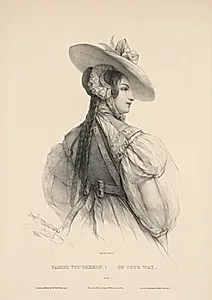
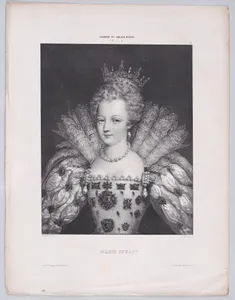
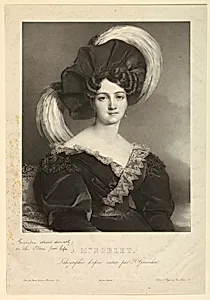
Returning to France, Grévedon recognized the commercial and artistic potential of lithography, the printmaking technique invented in 1796 that was revolutionizing image reproduction and dissemination. He honed his skills as a lithographer to meet growing French demand for printed portraits, book illustrations, and popular imagery.
His lithographic work achieved the same high standards as his painting. At the Paris Salon, he was awarded a first-class medal for his lithographic drawings, recognition that placed lithography—often dismissed as merely commercial or reproductive—on par with traditional fine arts.
Grévedon's success in lithography demonstrated artistic and commercial acumen: he maintained traditional skills in painting while mastering new printmaking technologies, positioning himself to serve both fine art and commercial markets. This versatility ensured sustained income and relevance as artistic markets evolved.
His achievements earned him the honor of Knight of the Legion of Honor, France's highest distinction, recognizing both artistic merit and service to French culture. Beyond his artistic production, Grévedon was a notable art collector who had amassed numerous old master paintings during his lifetime, including Woman with a Pearl Necklace by Johannes Vermeer, demonstrating sophisticated connoisseurship. Henri Grévedon died on June 1, 1860, in Paris, with his funeral held at Notre-Dame-de-Lorette. His collection was subsequently sold, dispersing his holdings including the Vermeer painting that would later achieve canonical status in art history.
Artheon Research Team
Last updated: 2025-11-09
Biography length: ~493 words