
Ctrl K
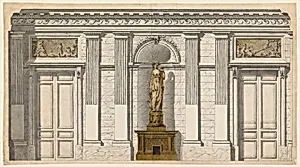
Henri Piètre (also spelled Piètre or Pièttre), a French architect and ornamental draughtsman active in the late eighteenth century, is best known for his intricate designs for the interiors of the Palais-Royal in Paris. Working primarily as the architect to Louis Philippe Joseph d'Orléans (known as "Louis-Philippe the Fat," 1725–1785), Piètre oversaw numerous renovations and decorative schemes from around 1769 until the duke's death in 1785. His career reflects the opulent architectural patronage of the Orléans family during the final decades of the Ancien Régime, though details of his early life and formal training remain sparsely documented, with no records of specific teachers or art schools identified.
Piètre's oeuvre centers on architectural drawings executed in pen and ink, gray wash, watercolor, and gouache, blending Rococo exuberance with emerging Neoclassical restraint. He produced detailed projects for grand spaces like vestibules, galleries, and salons, often featuring sculptural niches, ornate paneling, and symmetrical compositions suited to aristocratic interiors. Notable among his preserved works are designs for the Galerie d'Enée and the Galerie des Hommes Illustres at the Palais-Royal (1778), held at the Musée Carnavalet, as well as a vestibule project with paired doors and a central stove surmounted by sculpture, akin to one sold at auction. He collaborated with contemporaries such as Alexandre-Théodore Brongniart on projects like the Hôtel du Duc d'Orléans (1773) and Jean-Charles Delafosse on ornamental elements, contributing to the sophisticated "goût grec" style popular in elite circles.
Though Piètre's life ended sometime between 1785 and 1796—possibly at 68 rue Lhomond in Paris—his legacy endures through the surviving sheets that illuminate the decorative ambitions of pre-Revolutionary France. A poignant example in our virtual museum's collection, *Design for a Wall with Two Doors and a Sculpture* (c. 1785), exemplifies his mastery of spatial orchestration and sculptural integration, rendered in pen, black ink, gray wash, and watercolor. Piètre's contributions, though overshadowed by more famous contemporaries, offer invaluable insight into the architectural splendor of the Palais-Royal, a cultural hub that foreshadowed the upheavals of 1789.