
Ctrl K
**Hermann Wrede: Master Woodwind Maker of Regency London**
Hermann Wrede, a German émigré who became one of London's premier musical instrument makers, established his workshop in the early 19th century and specialized in finely crafted woodwinds such as clarinets and flutes. Listed in trade directories as a "Musical Wind Instrument Maker" from 1811, he operated initially from 15 St. John's Square in Clerkenwell between 1814 and 1829, producing instruments marked with his distinctive unicorn-head stamp and address details. His early life remains not well documented, though his Germanic origins influenced the precision evident in his boxwood, ivory, and brass creations, which catered to professional musicians and music sellers like Button & Whittaker and W. Howlett of Norwich.
Wrede's career weathered significant setbacks, including a devastating fire in October 1830 that destroyed his house and extensive workshops at 35 Lower Whitecross Street, Cripplegate—his new premises by 1837. Rebuilding swiftly, he expanded into piano making and importing by 1837, employing a small team of journeymen such as Bellamy, Norvell, and Cowland amid tensions with early trade societies like the Flute-makers’ Burial Society. His instruments, often featuring ivory ferrules and silver or brass keys, exemplified the transitional style of English woodwinds during the Regency and early Victorian eras, blending traditional boxwood construction with emerging key mechanisms for improved intonation and playability.
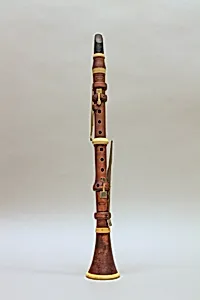
Among Wrede's surviving masterpieces are a Clarinet in C (ca. 1815–30) and a Clarinet in F (ca. 1837–40), both housed in The Metropolitan Museum of Art, showcasing his evolution from simpler five- to six-key models to more complex designs. The Bate Collection at Oxford University preserves additional gems, including an ivory-mounted Clarinet in E♭ and a ten-key Clarinet in C, both stamped from his Whitecross Street address and sold via Norwich dealers. He also crafted flutes, such as four-key models in C with original ivory bands, prized by collectors today.
Wrede's legacy endures through these museum pieces, which highlight the craftsmanship of London's instrument trade at a time when woodwinds were evolving toward modern forms. Father to Robert William Wrede (1817–1857), who followed in the family trade, Hermann died in London in 1841, leaving a modest but influential mark on musical history. His instruments, blending functionality with elegant materials, continue to inspire performers and scholars of historical musicology.
All 2 artworks loaded
