Ctrl K
1916–1961
Herndon Hightower (1916–1961) was an American artist whose surviving works consist of precise watercolor renderings created for the Index of American Design, a Federal Art Project of the Works Progress Administration. Active during the late 1930s, he contributed to this nationwide effort to document the decorative and utilitarian arts of the United States from the colonial period through the nineteenth century. The Index employed hundreds of artists to produce more than 18,000 plates now held by the National Gallery of Art, emphasizing accurate visual records over personal artistic expression.
Hightower’s early life and training are not well documented. No records identify a specific teacher, mentor, or art school affiliation. His known output belongs firmly to the documentary tradition of the Index, executed in watercolor combined with graphite, pen and ink, and colored pencil. These techniques allowed him to capture the exact form, surface texture, construction details, and even original dimensions of everyday objects, treating them as artifacts of American material culture rather than subjects for imaginative interpretation.
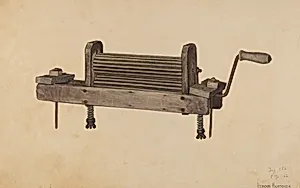
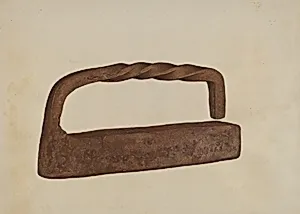
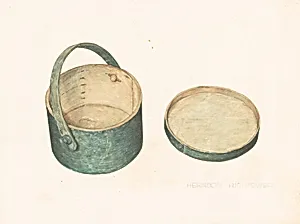
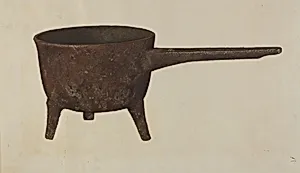
Among his documented plates are Tailor’s Iron (c. 1938), Clothes Pin Basket (c. 1938), Clothes Wringer (c. 1939), and Iron Kettle (c. 1939). Each work isolates a single household item—an iron with a twisted handle, a wooden basket for clothespins, a mechanical wringer, or a three-legged kettle—rendered with clinical clarity against a plain background. Inscriptions on several sheets confirm his authorship, and the plates were later reproduced in publications such as Erwin O. Christensen’s The Index of American Design (1950) and Clarence P. Hornung’s Treasury of American Design (1970).
Hightower’s contribution, though modest in number, forms part of a landmark archival project that preserved a visual encyclopedia of American craftsmanship at a moment when many such objects were disappearing. The Index plates continue to serve scholars, designers, and the public as an invaluable resource for understanding the nation’s folk-art heritage, ensuring that the anonymous makers of these utilitarian objects remain visible through the careful labor of artists like Hightower.
All 4 artworks loaded