
Ctrl K
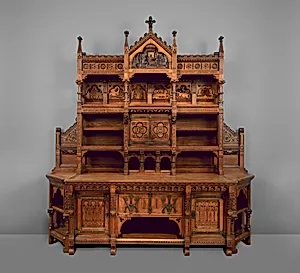
Bruce James Talbert (1838–1881), a Scottish-born designer pivotal to Victorian Britain's Aesthetic Movement, began his career in Dundee, where he studied at the High School before apprenticing under local woodcarver Millar. He pursued architectural training in Glasgow, working under Charles Edward (ca. 1855–57), as assistant to William Nairne Tait (1857–60), and as draftsman for Campbell Douglas (1860–62). These formative years honed his skills in carving and drafting, laying the foundation for his shift toward furniture and interior design.
In 1862, Talbert relocated to Manchester to create furniture for Doveston, Bird & Hull, then briefly joined Francis Skidmore's Art Manufactures in Coventry. His breakthrough came in 1866 upon moving to London, where he designed exclusively for the prestigious firm Holland & Sons, renowned cabinetmakers since 1803. With Holland & Sons, he earned a silver medal at the 1867 Paris International Exhibition for a display including his innovative sideboards. Talbert championed the Reformed Gothic—or Modern Gothic—style, characterized by bold geometric inlays of boxwood and thuya, low-relief carvings, spindle motifs, and framed constructions with oversized metal hinges, blending medieval rigor with practical domesticity.
Talbert's oeuvre includes landmark pieces like the Pericles Dressoir sideboard (1866, Holland & Sons; Metropolitan Museum of Art), engraved with verses from Shakespeare's *Pericles*, and the Sleeping Beauty Sideboard (1867, Holland & Sons; Victoria and Albert Museum). Later highlights encompass the Pet Sideboard and Dundee Cabinet (ca. 1871–72, Gillow & Co.; V&A and Lancaster's Judges' Lodgings) and the Grand Prix-winning Juno Cabinet (1878, Jackson & Graham; V&A). He also authored influential pattern books: *Gothic Forms Applied to Furniture* (1868), *Examples of Ancient & Modern Furniture* (1876), and the posthumous *Fashionable Furniture* (1881).
Talbert's designs profoundly shaped transatlantic tastes, inspiring American firms like Herter Brothers and architects such as Frank Furness, while his work endures in major collections. Tragically, he died at 43 from alcoholism, yet his legacy as a bridge between Gothic revivalism and Aesthetic eclecticism remains unmatched.