Ctrl K
1520–1601
**Hugues Sambin** (c. 1520–1601) was a versatile French craftsman, sculptor, architect, and designer from the Franche-Comté region who became one of the leading figures of Mannerist art in Burgundy and eastern France. Born in Gray, he trained as a *menuisier* (woodworker or joiner) and came from a family of wood-carvers; his father was Mammes Sambin, and his brothers Guillaume and Claude also worked in the trade. He established his career in Dijon, where he rose to master *menuisier* in 1549 and later described himself as an *architecteur*.
Sambin’s artistic formation was shaped by direct exposure to the French Renaissance court style. In 1544 he spent six months working at the Palace of Fontainebleau, absorbing the sophisticated Mannerist vocabulary of the School of Fontainebleau with its elongated figures, strapwork, and exuberant ornament. This experience informed his lifelong preference for theatrical, overcharged decorative schemes. He also participated in the elaborate temporary architecture and decorations for royal entries into Dijon, including those of Henri II in 1548 and Charles IX in 1564.
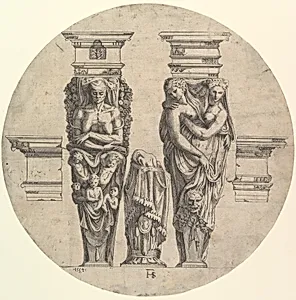
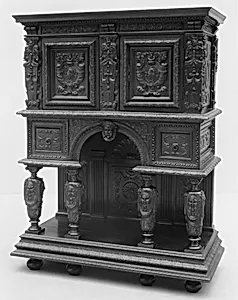
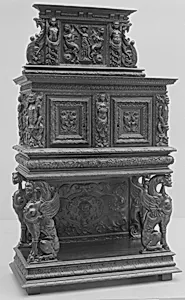
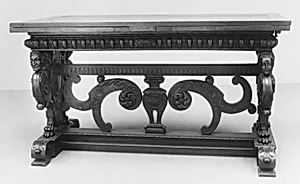
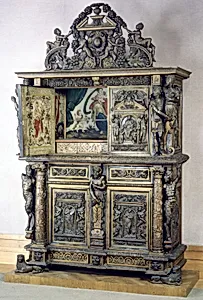
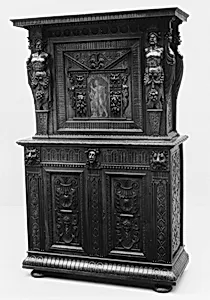
His most enduring contribution was the 1572 publication *Œuvre de la diversité des termes dont on use en architecture*, a suite of thirty-six engraved plates illustrating inventive Mannerist caryatid terms and ornamental motifs that were widely copied for luxury furniture such as cabinets, dressers, and armoires. As an architect he designed the main door of the Parlement of Burgundy (now the Palais de Justice) in Dijon (1580), contributed to the Parlement building in Besançon, and created the ornate porch supported on caryatids at the Hôtel Milsand in Dijon. He collaborated on projects with his son David Sambin, also a wood-carver, and worked for prominent patrons including Léonor Chabot.
Sambin’s legacy lies in his synthesis of wood-carving tradition with high-style Mannerist design, which left a lasting mark on the ornamental repertoire of the region. His published patterns continued to influence furniture makers into the seventeenth century, and his exuberant style was revived in nineteenth-century Renaissance Revival architecture. Though many of his architectural commissions have been lost or altered, surviving works and his influential engravings secure his place as a defining regional master of the French Renaissance.