
Ctrl K
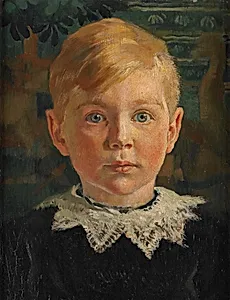
Huibert Marie "Huib" Luns (1881-1942) was a Dutch painter, sculptor, writer, and influential art educator whose multifaceted career spanned teaching, artistic creation, and cultural administration during a transformative period in Dutch art. Born in Paris to Dutch parents and educated in Amsterdam, Luns developed a versatile practice encompassing portraiture, landscape painting, nude studies, sculpture, poster design, book covers, and medal creation, while simultaneously building one of the most distinguished teaching careers in Dutch art education. Luns's significance extends beyond his artistic production to his profound influence on Dutch art education. He held successive positions at the Rotterdam Academy (1908-1917), the Academy of 's-Hertogenbosch as director (1917-1923), the Rijksinstituut voor Opleiding van Tekenleraren (National Institute for the Training of Drawing Teachers) in Amsterdam as director (1923-1931), and finally as professor at Delft University of Technology (1931-1942). His son Joseph Luns would achieve international prominence as NATO Secretary-General (1971-1984), demonstrating the family's continued impact on Dutch and international affairs.
Huibert Marie Luns was born on June 6, 1881, in Paris, France, where his Dutch parents were temporarily residing. Despite his Parisian birth, Luns was raised in the Netherlands and received his entire artistic education in Dutch institutions.
Luns received his first drawing lessons from the brothers Antoon and Theo Molkenboer, established Dutch artists who provided him with foundational skills in academic drawing and composition. This private instruction gave him a strong technical base before entering formal art schools.
He continued his education at the Rijksnormaalschool for arts and crafts in Amsterdam, an institution focused on training teachers and craftspeople in applied arts. This pedagogical emphasis would prove significant for his later career as an influential art educator.
Luns then served an internship at the Rijksacademie (Royal Academy) in Amsterdam, the Netherlands' premier art school. There he encountered the latest developments in Dutch art and received advanced training in painting and sculpture from leading academic artists. In 1904, Luns and fellow student Jan Sluijters both participated in the Prix de Rome competition, the most prestigious award for young Dutch artists. Sluijters won the prize, going on to become one of the leading figures of Dutch modernism, while Luns pursued a different but equally influential path.
Following his education, Luns established himself as a working artist creating in multiple media. His paintings and drawings encompassed diverse subjects: numerous portraits of prominent Dutch figures capturing the political, cultural, and social elite of the Netherlands; nude studies demonstrating his academic training and interest in the human figure; elegant women depicted in sun-drenched landscapes, showing Impressionist influence; still lifes and colorful landscapes, often created during travels to southern regions including beach and cityscapes.
His artistic style ranged from realistic rendering akin to that of his teachers the Molkenboers, through Symbolist mystery and suggestion, to a loose, impressionistic palette influenced by French modernism. This stylistic versatility reflected both his solid academic training and his openness to contemporary artistic developments.
Beyond painting, Luns worked as a sculptor, created designs for book covers, designed posters that combined Art Nouveau decorative principles with effective communication, and even designed medals, demonstrating his facility across fine and applied arts. This breadth of practice was characteristic of successful Dutch artists of his generation who moved fluidly between different media and commercial and fine art applications.
In 1908, Luns began his distinguished teaching career with an appointment at the Rotterdam Academy, one of the Netherlands' important regional art schools. For nine years, he trained the next generation of Dutch artists while continuing his own artistic practice.
In 1917, recognizing his administrative abilities and artistic authority, Luns was appointed director of the Academy of 's-Hertogenbosch (also known as Den Bosch), a historic city in the southern Netherlands. As director from 1917 to 1923, he shaped curriculum, hired faculty, and determined the artistic direction of the institution during the post-World War I period.
His directorship coincided with significant changes in European art education as academic traditions faced challenges from modernist movements. Luns had to navigate between maintaining technical standards rooted in academic training while acknowledging new artistic directions emerging from Cubism, Expressionism, and other avant-garde movements.
His success at 's-Hertogenbosch led to his next appointment: in 1923, he became director of the Rijksinstituut voor Opleiding van Tekenleraren (National Institute for the Training of Drawing Teachers) in Amsterdam, the Netherlands' premier institution for training art teachers.
As director of the National Institute for the Training of Drawing Teachers from 1923 to 1931, Luns influenced Dutch art education at the national level. He shaped the pedagogical approaches and technical standards for art teachers throughout the Netherlands, affecting thousands of students through the teachers he trained.
In 1931, Luns received appointment as professor of Hand Drawing and Art History at the Delft University of Technology (Technische Universiteit Delft), one of the Netherlands' premier technical universities. This position reflected recognition that art and design education were essential components of technical and engineering training.
At Delft, Luns taught from 1931 until his death in 1942, spanning the period of Nazi occupation of the Netherlands (1940-1945). Teaching during the occupation required navigating difficult ethical and practical challenges as the Nazi regime attempted to control Dutch cultural and educational institutions.
Throughout his teaching career, Luns continued producing art work, demonstrating to his students that successful artists could combine teaching with active creative practice. His family life included six children, among them Joseph Luns, who would become one of the Netherlands' most prominent diplomats, serving as Minister of Foreign Affairs (1952-1971) and Secretary-General of NATO (1971-1984). Huib Luns died on February 24, 1942, in Amsterdam during the Nazi occupation, leaving behind a legacy of artistic works and, more significantly, having shaped Dutch art education for over three decades through his teaching, administrative leadership, and pedagogical vision.
Artheon Research Team
Last updated: 2025-11-09
Biography length: ~497 words
All 2 artworks loaded
