Ctrl K
1661–1721
Benoît Audran the Elder (also known as Benoît Audran I) was born on 23 November 1661 in Lyon, France, the second son of the engraver Germain Audran and a member of the distinguished Audran family of artists active in Lyon and Paris. He received his first instruction in engraving from his father before traveling to Paris as a young man to study under his uncle, the celebrated Gérard Audran. This rigorous family training shaped his career as a reproductive engraver specializing in historical subjects and portraits.
Audran’s style was bold and clear, with correct drawing of the figure and a fine expression of character in his heads, echoing the manner of his uncle though he never fully equalled Gérard’s mastery. He sometimes imitated his teacher’s brilliant, fluid burin work but achieved greater distinction when following his own more restrained instincts, emphasizing harmony of line, pictorial decorum, and expressive dignity drawn from the French school of painters. In 1709 he was received into the Académie Royale de Peinture et de Sculpture (presenting a portrait of Jean-Baptiste Colbert after Claude Lefebvre and an Elevation of the Cross after Charles Le Brun); he later became a counselor and was appointed graveur du roi with a royal pension.
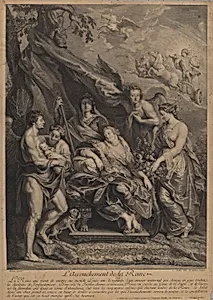
Among his principal plates are portraits such as Jean-Baptiste Colbert (1676) after Lefebvre, Henri de Beringhen after Nanteuil, and several after Joseph Vivien. His reproductive engravings include biblical and historical scenes after Le Brun (The Elevation of the Cross, 1706; Moses defending the Daughters of Jethro; The Descent from the Cross), after Rubens from the Marie de’ Medici cycle at the Luxembourg Palace (The Accouchement of Marie de Médicis and The Exchange of the Two Queens), after Eustache Le Sueur (Alexander and his Physician; St. Paul Preaching at Ephesus), and after Albani, Antoine Coypel, and Pierre Mignard. He also illustrated Les Amours pastorales de Daphnis et Chloé (1718). More than two hundred prints are recorded.
Audran died on 3 September 1721 in the village of Ouzouer near Sens. His technically accomplished engravings helped disseminate major works of French and Flemish painting to a wider public and secured his reputation within the Audran dynasty; his portrait after Vivien was later engraved by his nephew Benoît Audran the Younger, who continued the family tradition.