
Ctrl K
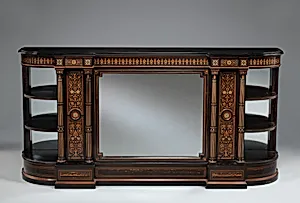
**Jackson & Graham was a leading London cabinetmaking firm active from around 1840 to 1885, renowned for its collaborations with the influential designer Owen Jones.** Established in 1836 by Thomas Jackson and Peter Graham at 37 Oxford Street, the firm specialized in high-quality furniture and quickly became one of Britain’s most respected manufacturers, exhibiting at major international shows and supplying luxurious pieces to wealthy clients.
Their work embodied the Victorian era’s fascination with eclectic ornament, drawing heavily on Jones’s theories outlined in *The Grammar of Ornament* (1856). Jones, who frequently partnered with the firm, introduced non-Western decorative motifs—Arabic, Persian, and Indian among them—into furniture design. Pieces often featured intricate marquetry, ebony inlays with holly and purpleheart, and surface patterns that prioritized flat, colorful ornament over three-dimensional carving, aligning with Jones’s advocacy for honest, culturally informed decoration.
Notable examples include a marquetry and ebony chaise longue designed by Jones and made by the firm circa 1867–70, an ebony-and-ivory cabinet from around 1863, and various bookcase panels and armchairs that showcase Jones’s geometric and floral motifs executed in fine woods. These works demonstrate the firm’s technical mastery and its role in translating Jones’s two-dimensional designs into three-dimensional luxury objects.
Jackson & Graham’s legacy lies in elevating British furniture production during the mid-Victorian period. By engaging leading designers like Jones, Bruce Talbert, and others, the firm helped popularize a sophisticated, internationally inspired aesthetic that influenced later Aesthetic Movement interiors. In 1885 the company was absorbed by Collinson and Lock, but its output remains prized in museum collections for its craftsmanship and historical significance.