
Ctrl K
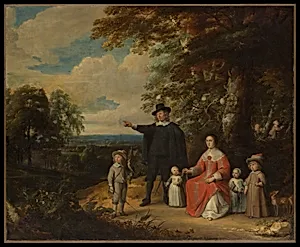
**Jacques d'Arthois** (baptized 12 October 1613 – May 1686) was a Flemish painter and tapestry designer renowned for his wooded landscapes featuring figures, often set in the forests surrounding his native Brussels. Born as Jacques van Arthois, the son of Henri Artois, he trained as an apprentice to Jan Mertens starting in 1625 and achieved master status in the Brussels Guild of St. Luke in 1634.
He married Maria Sampels and had eight children, including his son Jan Baptist, who followed in his footsteps as a landscape painter working in a similar style. D'Arthois maintained a productive workshop that trained several pupils, among them his brother Nicolaes and artists such as Alexander van Herssen. He was particularly influenced by fellow Brussels landscape painters Denis van Alsloot and especially Lodewijk de Vadder, whose approach shaped his early compositions.
D'Arthois specialized in expansive wooded scenes, frequently collaborating with figure painters like David Teniers the Younger and Gonzales Coques to populate his canvases. He gained recognition for both intimate and monumental works, the latter often commissioned for churches and abbeys. In 1655 he was appointed official tapestry cartoon designer for Brussels, succeeding de Vadder. As a leading member of the so-called Sonian Forest painters, he helped define a distinctive local school focused on the region’s natural scenery.
His legacy endured through the many imitators who adopted his decorative grandeur and detailed rendering of moss-covered trees and foliage. Though only a few works are dated, engravings after his paintings from around 1650 allow scholars to trace his evolution from relatively spare early landscapes to more elaborate, colorful later compositions. Today he is remembered as one of the most influential 17th-century Brussels landscape artists whose style continued to resonate for generations.