**James Castle: A Self-Taught Visionary of Rural America**
James Charles Castle was born on September 25, 1899, on a remote farm in Garden Valley, Idaho, to Frank and Mary Castle, local postmasters and the parents of seven children, of whom he was the fifth. Profoundly deaf from birth, Castle attended the Gooding School for the Deaf and Blind from ages ten to fifteen but never mastered sign language, lip-reading, or conventional reading and writing. Entirely self-taught as an artist, he began drawing around age six, capturing the textures of his isolated world without formal instruction or exposure to the broader art world. After family moves—to Star, Idaho, in 1923, following his father's death in 1927, and then to Boise in 1931 with his mother—Castle continued his solitary practice, later living with his sister Agnes (Peggy) Wade and her family after Mary's death in 1948.
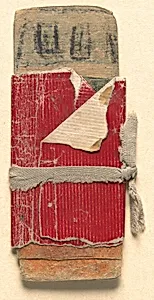
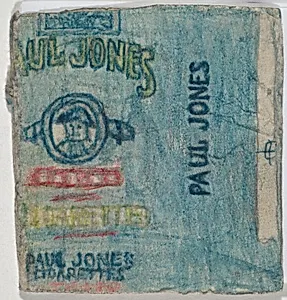
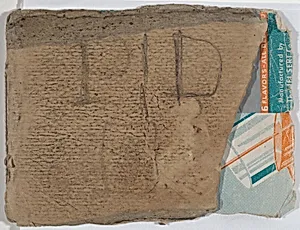
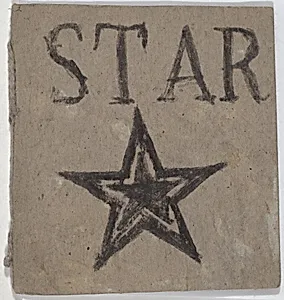
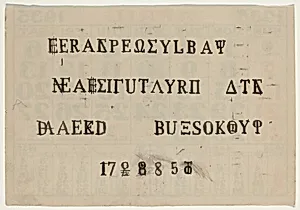
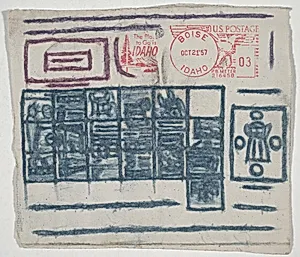
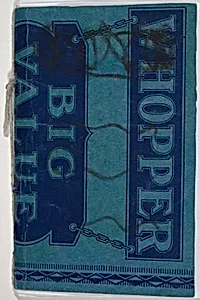
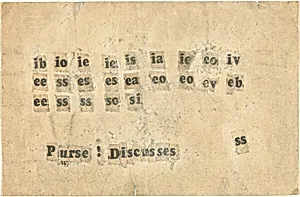
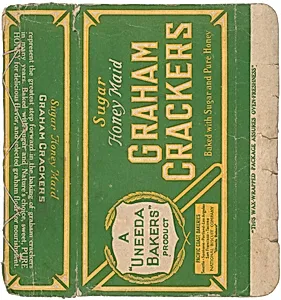
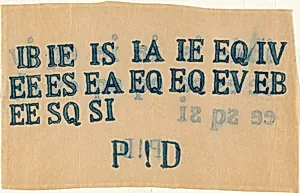
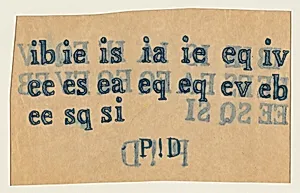
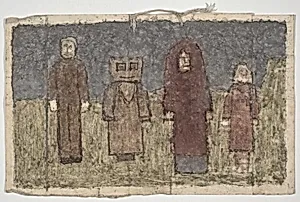
Castle's oeuvre, spanning thousands of works primarily from 1931 until his death on October 26, 1977, defies categorization yet resonates with raw ingenuity. He eschewed commercial art supplies, instead grinding soot from the family woodstove with saliva to create ink, applied via sharpened sticks, matchsticks, or rags onto salvaged papers from envelopes, packaging, and advertisements. His monochromatic drawings evoke intimate interiors, farmhouses, figures in motion, animals, and enigmatic text-like symbols derived from his surroundings. Extending into three dimensions, Castle crafted handmade books bound with twine and intricate assemblages—corrugated cardboard sculptures of clothed figures, room interiors, and architectural forms, stitched with commercial thread and affixed with sealing wax. These works, often depicting his Eugene Street home in Boise, blend folk realism with modernist abstraction, born from lived observation rather than academic tradition.
Though unrecognized during much of his life, Castle's art gained acclaim in the early 1950s when his nephew, Bob Beach, shared drawings with instructors at Portland's Museum Art School, leading to regional exhibitions and solo shows at the Boise Gallery of Art in 1963 and 1976. Posthumously, major retrospectives followed: the Philadelphia Museum of Art's touring show (2008–2009), Madrid's Museo Reina Sofía (2011), the 2013 Venice Biennale, Smithsonian American Art Museum's *Untitled* (2014), and Whitney Museum's *Where We Are* (2017). Today, institutions like the Smithsonian (holding 54 pieces) and Whitney celebrate his legacy as a pinnacle of self-taught outsider art, challenging hierarchies of training and ability while illuminating the profound creativity emerging from silence and seclusion. Castle's Boise family home now serves as the James Castle House, a cultural center preserving his singular vision for future generations.

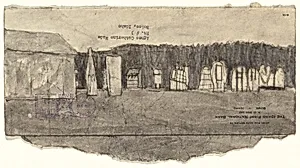
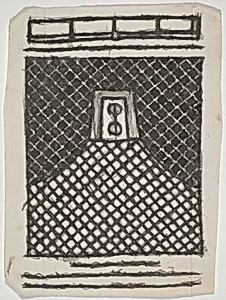
![Untitled (Shed Interior with Pictures on Display) [verso]](https://images.artheonmuseum.org/nga/thumb/untitled-shed-interior-with-pictures-on-display-nga-167940.webp)
![Untitled (Shed Interior) [verso]](https://images.artheonmuseum.org/nga/thumb/untitled-shed-interior-verso-nga-167942.webp)
![Untitled (short ribs) [verso]](https://images.artheonmuseum.org/nga/thumb/untitled-short-ribs-verso-nga-167941.webp)
![Untitled (Interior with Pictures) [verso]](https://images.artheonmuseum.org/nga/thumb/untitled-interior-with-pictures-verso-nga-167944.webp)
![Untitled (Man on Patterned Background) [verso]](https://images.artheonmuseum.org/nga/thumb/untitled-man-on-patterned-background-verso-nga-167946.webp)
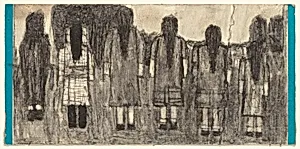
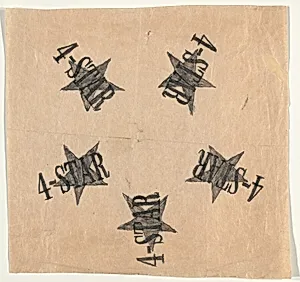
![Untitled (Shed Interior with Pictures on Display) [recto]](https://images.artheonmuseum.org/nga/thumb/untitled-shed-interior-with-pictures-on-display-nga-159405.webp)
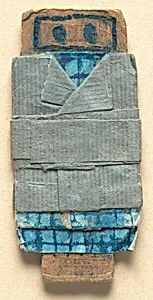
![Untitled (SHORT RIBS) [recto]](https://images.artheonmuseum.org/nga/thumb/untitled-short-ribs-recto-nga-159409.webp)