
Ctrl K
1725–1811
Jean-Baptiste Réveillon (1725–1811) rose from humble apprenticeships as a tradesman, haberdasher, and stationer in Paris to become the preeminent French wallpaper manufacturer of the 18th century. Marrying advantageously, he leveraged his wife’s dowry to experiment with velvet paper production. In 1753, amid growing demand among the bourgeoisie for affordable luxury, Réveillon began importing and installing English flock wallpapers. The Seven Years’ War disrupted imports, prompting him to manufacture his own in 1759 after relocating to the Faubourg Saint-Antoine district. There, he transformed the ground floor of the opulent La Folie Titon mansion—purchased in 1765—into a sprawling factory, while residing in the upper stories with its park and theater.
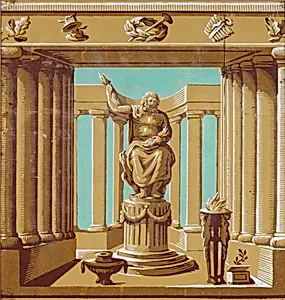
Réveillon’s enterprise flourished under noble patronage, employing around 300 workers and pioneering innovations like a dedicated paper mill in 1775, a Tuileries showroom in 1776, and a novel vellum paper process in 1782. Granted the title *Manufacture Royale* in 1783, he collaborated with landscape painter Jean-Baptiste Pillement to develop vibrant, fast-drying colors and hired silk and tapestry designers for exquisite patterns. His wallpapers embodied the Louis XVI style’s neoclassical elegance—arabesques, Pompeian motifs, and scenic vignettes—printed in rich hues on grounds like sky blue with fleurs-de-lys.
Among his triumphs, Réveillon supplied *papier bleu d’Angleterre* for Queen Marie Antoinette’s apartments and crafted colorful coverings for the Montgolfier brothers’ pioneering hot-air balloons, launched from his garden in 1783—including one named *Le Réveillon* featuring a rooster, duck, and sheep. Works like the *Hearing (L’Ouïe)* panel from a five-senses series and Toile de Jouy imitations endure in collections at the RISD Museum and Victoria & Albert Museum. Tragedy struck in April 1789 during the Réveillon Riots, when a misinterpreted economic statement sparked a mob to raze his factory and mansion; he escaped over a wall to the Bastille, fleeing to England with his fortune.
Réveillon leased his firm to Jacquemart & Bérnard in 1791, sustaining production until 1840 and cementing his legacy as a self-made innovator who elevated wallpaper from craft to high art, influencing neoclassical decorative traditions across Europe.