Ctrl K
1732–1797
**Jean-Bernard Restout** (22 February 1732 – 18 July 1797) was a French painter, draughtsman, and engraver born and died in Paris. He belonged to a prominent dynasty of artists as the son of Jean Restout II, a leading religious painter and member of the Académie de Rouen.
Restout studied under his father before entering the competitive world of the Académie royale. He placed second in the Prix de Rome in 1755 and won first prize in 1758 with his painting *Abraham Leading Isaac to the Sacrifice*, which funded four years of study in Rome. Upon returning, he was agréé by the Académie in 1765, received as a full member in 1769, and appointed professor in 1771. Like his father, he maintained ties to the Académie de Rouen.
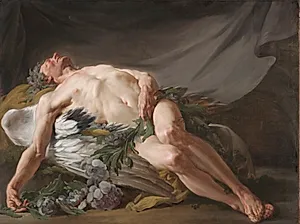
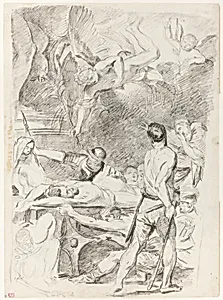
His career reflected both adherence to and rebellion against institutional norms. He exhibited regularly at the Salon de Paris from 1767 to 1791, producing works such as *Diogenes Asking for Alms* (1767), *Young Woman with a Guitar* (1768), *Philemon and Baucis Giving Hospitality to Jupiter and Mercury* (1769), and the celebrated *Sleep* (also known as *Morpheus*, 1771). His refusal to conform strictly to Académie rules sparked conflicts, yet he remained active in official circles until the Revolution. In 1793 he became president of the Commune des Arts alongside Jacques-Louis David, advocating the abolition of the Académie’s privileges. Appointed guardian of the Garde-Meuble royal, he faced imprisonment during the Reign of Terror but was released after the fall of Robespierre in 1794.
Restout’s legacy lies in his navigation of late-eighteenth-century artistic and political upheavals. Working within the Rococo tradition of his family while engaging neoclassical currents, he left a body of history paintings, portraits, and allegories that bridged generations. His self-portrait of 1794 and other surviving works continue to illustrate the tensions between tradition and reform that defined his era.