Ctrl K
1775–1842
Jean-Victor Bertin (1767–1842) was a leading French neoclassical landscape painter whose meticulous classical compositions bridged the grandeur of historical landscapes with emerging plein air naturalism. Born in Paris on March 20, 1767, to a master wig-maker, Bertin entered the Académie royale de peinture et de sculpture in 1785 at age eighteen as a pupil of history painter Gabriel-François Doyen. From 1788, he studied under the influential landscape artist Pierre-Henri de Valenciennes, whose emphasis on direct observation from nature profoundly shaped Bertin's approach.
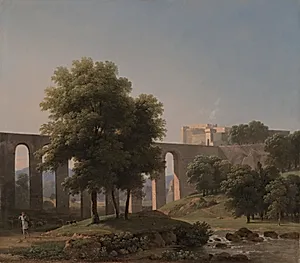
Bertin's career flourished through consistent participation in the Paris Salon from 1793 until his death, earning a prix d'encouragement in 1799, a first-class gold medal in 1808, and the Légion d'honneur in 1822. He traveled to Italy from 1806 to 1808, capturing the Roman Campagna in sketches that informed his later works. A pioneer advocate for landscape painting's prestige, Bertin proposed the Prix de Rome for historical landscapes in 1801, realized in 1816 thanks to Valenciennes's endowment; the first winner was his pupil Achille Etna Michallon. Commissions followed for the palais du Trianon and palais de Fontainebleau between 1811 and 1817, including redecorations at the Grand Trianon and Galerie de Diane in 1819. His style evolved from idealized, Italy-inspired scenes with minute detail—often in porcelain-smooth finishes—to looser, impasto-heavy oil sketches en plein air, foreshadowing romanticism.
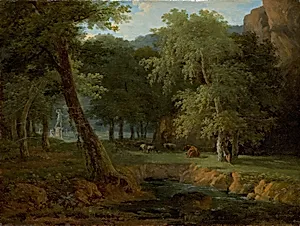
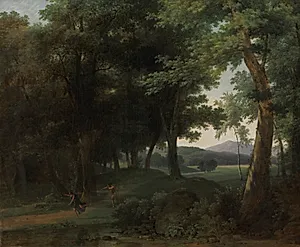
Among Bertin's major works are *Classical Landscape with Figures* (1803, Metropolitan Museum of Art), *View in the Île-de-France* (c. 1810–1813, J. Paul Getty Museum), *Shepherd with His Flock* (c. 1820, National Gallery of Art), and *Deer at the Edge of a Wood* (1835, Metropolitan Museum of Art). Mythological and historical subjects like *The Festival of Pan*, *The Offering to Venus*, *Cicero's Return from Exile*, and *View of the Island of Phoenos with the Temple of Minerva* (Louvre) exemplify his neoclassical precision, while later pieces adorn Versailles and provincial museums acquired by the state from 1833.
Bertin's legacy endures as a pivotal teacher bridging neoclassicism and romanticism; his studio hosted luminaries like Léon Cogniet, Antoine-Félix Boisselier, Jean-Baptiste-Camille Corot (who studied there five years after Michallon's death), and Auguste-Jean Rémond. Despite late-life financial woes leaving his widow destitute, his advocacy elevated landscape painting, influencing generations toward nature's direct study.