Ctrl K
1788–1857
**Johan Christian Claussen Dahl (1788–1857)** was a Norwegian painter widely regarded as the founder of the “golden age” of Norwegian painting and the father of Norwegian landscape art. Born in Bergen on 24 February 1788 to a modest fishing family, Dahl received his earliest training in his hometown. From 1803 to 1809 he studied with the local painter Johan Georg Müller, whose workshop produced theatrical sets, portraits, and views of Bergen. A sympathetic mentor, Lyder Sagen, introduced him to art literature and arranged financial support that enabled Dahl to travel to Copenhagen in 1811 for further study at the Royal Danish Academy of Fine Arts.
In Copenhagen, Dahl immersed himself in the city’s collections and the surrounding countryside, drawing particular inspiration from the Dutch masters Jacob van Ruisdael and Allaert van Everdingen. He quickly gained recognition, exhibiting thirteen works in 1815 and attracting the patronage of Prince Christian Frederik. Seeking greater artistic independence, Dahl moved to Dresden in 1818, where he formed a close friendship with Caspar David Friedrich. The two artists shared a commitment to direct observation of nature while rejecting academic conventions. Dahl also spent ten formative months in Italy (1820–21), where the intense southern light encouraged a more spontaneous and luminous approach to landscape. His mature style blended Norwegian romantic nationalism with German romanticism, producing atmospheric scenes that captured both the grandeur and the intimate character of northern nature.
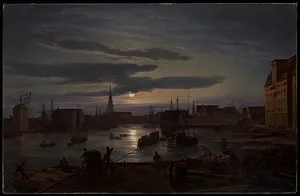
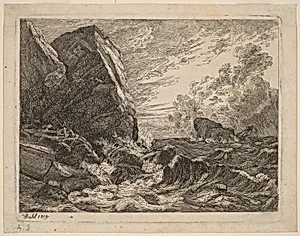
Among his most celebrated works are *View from Stalheim* (1842), *Shipwreck on the Coast of Norway* (1832), and numerous moonlit views of Dresden and the Elbe. Although he spent much of his career abroad, Dahl remained deeply committed to Norwegian culture. He played a pivotal role in establishing the Norwegian National Gallery and other institutions, advocated for the preservation of medieval stave churches, and supported the restoration of Nidaros Cathedral and Bergenhus Fortress. As a professor at the Dresden Academy he mentored a generation of Norwegian artists, including Knud Baade, Peder Balke, and Thomas Fearnley, encouraging them to develop individual styles rather than imitate his own. Dahl died in Dresden on 14 October 1857, leaving a legacy that continues to define Norwegian landscape painting.