Ctrl K
**Johannes Warnardus Bilders (1811–1890)** was a Dutch landscape painter born in Utrecht on 18 August 1811 as the son of a baker’s assistant. He was the only member of his family with artistic ambitions. He began his training with drawing lessons at the Vaktekenschool in Utrecht and later studied under the painter Jan Lodewijk Jonxis. His education was interrupted in 1830 when he volunteered as a soldier during the Belgian Revolution, serving for several years before returning to his studies.
Bilders never received formal painting instruction but developed his skills by studying the works of Romantic landscape artists such as Barend Cornelis Koekkoek. He made study trips to Germany, including the Rhine and Ahr river valleys, Wiesbaden, and the Black Forest. In 1841 he settled in Oosterbeek in Gelderland, a picturesque area that became known as the “Dutch Barbizon.” There he attracted a circle of younger painters—including Anton Mauve, Paul Gabriël, and the Maris brothers—who formed the nucleus of what became the Oosterbeek School and later the Hague School. He lived alternately in Utrecht, Amsterdam, and Oosterbeek, spending extended periods in the capital between 1858 and 1880, where he associated with artists such as Jozef Israëls and Hendrik Willem Mesdag.
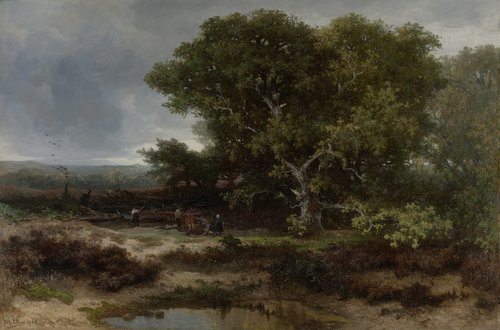
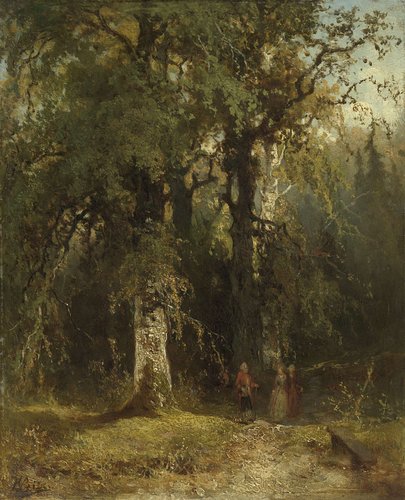
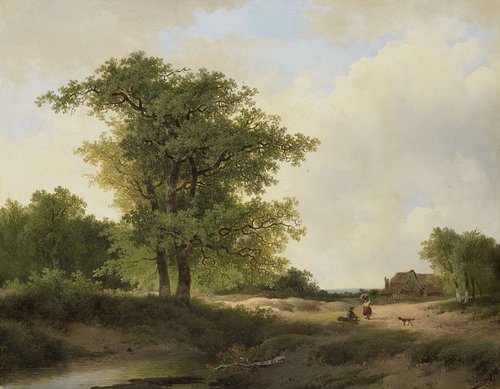
Bilders married Frederika Staudenmeijer in 1834; they had three children, among them the painter Gerard Bilders (1838–1865). After the deaths of his first wife and son from tuberculosis, he met the younger painter Marie van Bosse (later Marie Bilders-van Bosse) in Vorden. They married in 1880 and returned to Oosterbeek, where they spent their final decade together. His major works include *Landscape with Farm* (c. 1840–50), *Millennial Pine* (c. 1850), *View in the Woods* (c. 1860–80, Rijksmuseum), and several heath and forest scenes such as *Wolfhezen Heath* (c. 1860–75). He was knighted in the Order of the Netherlands Lion and participated in exhibitions across Europe and in the United States.
Bilders is remembered as a pivotal forerunner of the Hague School. His shift toward looser brushwork, lighter colors, and direct observation of nature—partly inspired by the French Barbizon painters—helped pave the way for the next generation of Dutch landscape artists. He died in Oosterbeek on 29 October 1890.
All 4 artworks loaded