
Ctrl K
1840–1875
**John and Charles Watkins: Pioneers of Victorian Portrait Photography**
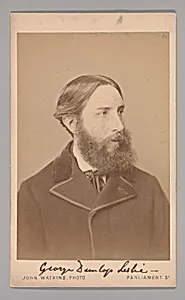
John Watkins (1823–1874) and his younger brother Octavius Charles Watkins (1836–1882) were prominent British portrait photographers whose collaborative studio captured the luminaries of Victorian Britain.) Born in Raglan, Monmouthshire, Wales, John began his career around 1840, establishing a studio at 34 Parliament Street in London by 1851, where the brothers frequently worked together under the name John & Charles Watkins from the 1860s until John's death.) A third brother, George Herbert Watkins (1828–1916), was influenced by John to pursue photography as well.) Operating during the carte-de-visite boom, they produced albumen prints and silver prints that documented artists, writers, politicians, and royalty with remarkable clarity and immediacy, reflecting the era's fascination with celebrity and mechanical reproduction.
Their oeuvre includes iconic portraits such as Charles Dickens (c. 1860 and 1859/1861), John Stuart Mill (1865, albumen print partially over-painted), William Powell Frith (1856–1857, carte-de-visite), and Thomas Carlyle, alongside figures like Charles Kingsley, Carlo Marochetti, Carl Haag, Sir Edwin Landseer, Frederic Leighton, and the Prince of Wales.) Other notable sitters encompassed Anna Maria Hall and Samuel Carter Hall (late 1860s) and Granville George Leveson-Gower, 2nd Earl Granville (early 1860s). These works, often small-format cartes circulated widely, democratizing access to images of the elite and blending photographic precision with subtle artistic enhancements.
The Watkins brothers' legacy endures in major collections: the National Portrait Gallery holds 335 of their portraits, the Victoria & Albert Museum 30 works, the Royal Academy 76, and institutions like the British Museum and Metropolitan Museum of Art feature their output. Active until 1875, their technically adept images preserved the faces of a transformative age, influencing the genre of celebrity portraiture and underscoring photography's rise as a vital art form in 19th-century Britain. Though early training details remain undocumented, their Parliament Street studio became a hub for capturing the Victorian cultural pantheon.)
![[Benjamin William Leader]](https://images.artheonmuseum.org/met/ph/thumb/benjamin-william-leader-685839.webp)
![[George Smith]](https://images.artheonmuseum.org/met/ph/thumb/george-smith-686073.webp)
![[Marshall C. Claxton]](https://images.artheonmuseum.org/met/ph/thumb/marshall-c-claxton-685479.webp)
![[Unknown Subject]](https://images.artheonmuseum.org/met/ph/thumb/unknown-subject-685932.webp)
![[Sir David Brewster]](https://images.artheonmuseum.org/met/ph/thumb/sir-david-brewster-685433.webp)
![[Alexander Johnston]](https://images.artheonmuseum.org/met/ph/thumb/alexander-johnston-685799.webp)
![[David Hall McKewan]](https://images.artheonmuseum.org/met/ph/thumb/david-hall-mckewan-685900.webp)
![[Unknown Subject]](https://images.artheonmuseum.org/met/ph/thumb/unknown-subject-686084.webp)
![[Alfred Pizzey Newton]](https://images.artheonmuseum.org/met/ph/thumb/alfred-pizzey-newton-685948.webp)
![[Marcus Stone]](https://images.artheonmuseum.org/met/ph/thumb/marcus-stone-686090.webp)
![[William Charles Thomas Dobson]](https://images.artheonmuseum.org/met/ph/thumb/william-charles-thomas-dobson-685576.webp)
![[Sir William Boxall]](https://images.artheonmuseum.org/met/ph/thumb/sir-william-boxall-685630.webp)
![[Solomon Alexander Hart]](https://images.artheonmuseum.org/met/ph/thumb/solomon-alexander-hart-685726.webp)
![[Frederick Richard Pickersgill]](https://images.artheonmuseum.org/met/ph/thumb/frederick-richard-pickersgill-685981.webp)
![[George Mason]](https://images.artheonmuseum.org/met/ph/thumb/george-mason-685895.webp)
![[Unknown Subject]](https://images.artheonmuseum.org/met/ph/thumb/unknown-subject-686206.webp)
![[Joseph John Jenkins]](https://images.artheonmuseum.org/met/ph/thumb/joseph-john-jenkins-685795.webp)
![[Florence Anne Claxton]](https://images.artheonmuseum.org/met/ph/thumb/florence-anne-claxton-685478.webp)
![[Henry O'Neil]](https://images.artheonmuseum.org/met/ph/thumb/henry-o-neil-686256.webp)
![[George Frederick Watts]](https://images.artheonmuseum.org/met/ph/thumb/george-frederick-watts-686146.webp)
![[Richard James Lane]](https://images.artheonmuseum.org/met/ph/thumb/richard-james-lane-685835.webp)
![[Frederick Goodall]](https://images.artheonmuseum.org/met/ph/thumb/frederick-goodall-685695.webp)
![[Unknown Subject]](https://images.artheonmuseum.org/met/ph/thumb/unknown-subject-686108.webp)