
Ctrl K
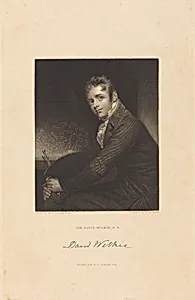
**John Henry Robinson (1796–1871)** was a leading English line and stipple engraver of the nineteenth century, renowned for his meticulous reproductions of portraits and historical scenes by major British and Old Master painters. Born in Bolton, Lancashire, and raised in Staffordshire, he began his training at age eighteen as a pupil of the established engraver James Heath, with whom he studied for about two years.
Robinson quickly established himself through book illustration and private commissions. In 1823 he received a prestigious commission from the Artists’ Benevolent Fund to engrave William Mulready’s *The Wolf and the Lamb*, earning 800 guineas for the plate. He exhibited early works at the Society of British Artists in 1824 and went on to produce illustrations for literary annuals and volumes such as Samuel Rogers’s *Italy* (after Thomas Stothard) and works by Gilbert Stuart Newton and Sir Edwin Landseer. Among his most notable achievements is the 1846 engraving *Sir David Wilkie, R.A.*, executed after a portrait by Sir William Beechey—the very work held in the collection.
His career was marked by advocacy for the professional status of engravers. In 1836–37 he joined petitions to Parliament and the Crown seeking full membership for engravers in the Royal Academy. Elected an Associate Engraver in 1856, he finally became a Royal Academician in 1867. He received a first-class gold medal at the 1855 Paris International Exhibition and was later made an honorary member of the Imperial Academy of Fine Arts in St. Petersburg. Late in life he married a woman of independent means and settled at New Grove, Petworth, Sussex, where he served as a justice of the peace.
Robinson’s legacy rests on the technical brilliance and fidelity of his plates, which preserved the likenesses of figures such as Van Dyck’s Earl of Derby and family, Murillo’s *Spanish Flower Girl*, and numerous portraits after Lawrence, Landseer, and others. He also engraved the first Belgian postage stamp (the “Epaulettes” issue). His work helped elevate reproductive engraving from craft to fine art, ensuring that the images of his era’s leading painters reached wide audiences long after the originals were created.