Ctrl K

1830–1910
John Quincy Adams Ward (1830–1910) was born in Urbana, Ohio, the fourth of eight children, and displayed an early aptitude for three-dimensional form, modeling figures in clay from childhood. In 1849 he moved to Brooklyn, New York, to apprentice under the sculptor Henry Kirke Brown, with whom he worked for seven years. Brown's emphasis on American subjects and his conviction that sculpture should speak to the experience of the new nation deeply shaped Ward's artistic philosophy. Alone among the major American sculptors of his generation, Ward chose deliberately not to study in Europe, refusing the neoclassical training in Rome that was then considered essential preparation for a serious sculptural career.
This choice was not merely logistical but ideological. Ward aligned himself with a naturalistic approach to the human figure that drew on direct observation rather than on the idealized conventions of antiquity. His commitment to American subjects and a forthright, unideal treatment of the body placed him at the head of a post–Civil War movement that sought a sculpture appropriate to a democratic republic. He established his New York studio in 1861 and quickly became the leading public sculptor of his era, receiving commissions for monuments throughout the northeastern United States.
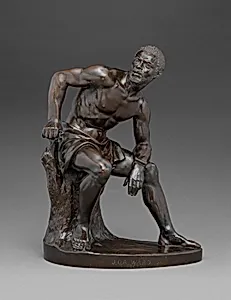
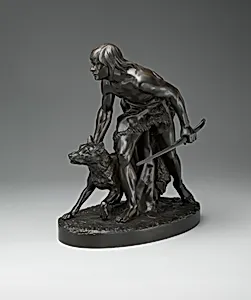
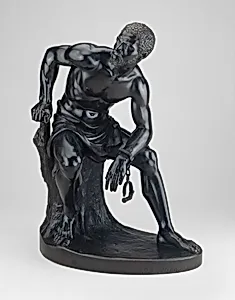
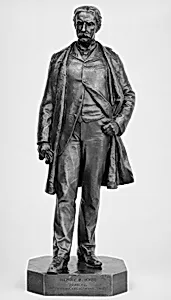
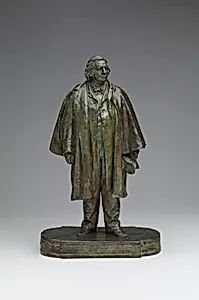
Among his most celebrated works is The Indian Hunter (modeled 1857, cast 1869), a naturalistic bronze depicting a Native American youth crouching with his dog, which was installed in Central Park in New York. The Freedman (1863) presented a newly liberated enslaved man with a dignity and psychological presence unusual in antebellum American sculpture. His public monuments include an imposing bronze of George Washington on the steps of Federal Hall in lower Manhattan, as well as equestrian and standing figures of Civil War generals and political leaders across several cities.
Ward was a powerful institutional force as well as a gifted artist: he served as president of the National Academy of Design and was a founder and long-serving president of the National Sculpture Society. His career effectively defined the terms of American public sculpture for a generation, and his insistence on home-grown artistic identity over European neoclassicism helped establish an independent tradition that successors would build upon well into the twentieth century.