Ctrl K
1564–1635
**Joos de Momper the Younger (c. 1564 – 5 February 1635)** was a Flemish landscape painter active in Antwerp during the late sixteenth and early seventeenth centuries. Born into an artistic family in Antwerp, he was named after his grandfather, a landscape painter and art dealer from Bruges. His father, Bartholomeus de Momper the Elder, was a painter, art dealer, printer, and publisher who provided his initial training.
De Momper became a master in the Antwerp Guild of St. Luke in 1581 at the remarkably young age of seventeen. It is believed he traveled to Italy in the 1580s, with landscape frescoes in the church of San Vitale in Rome now attributed to him. In 1590 he married Elisabeth Gobijn, and the couple had ten children, one of whom, Philippe de Momper, followed in his footsteps as a painter. His pupils included Louis de Caullery and his son Philippe; his followers encompassed his nephew Frans de Momper and Hercules Seghers. He enjoyed significant patronage, including support from Archduchess Isabella Clara Eugenia, who intervened on his behalf regarding taxes in his later years.
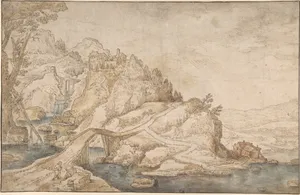
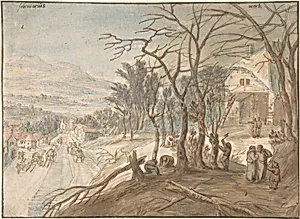
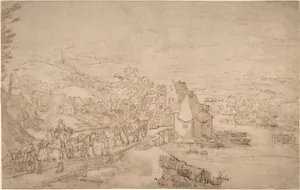
De Momper specialized in expansive landscapes that bridged late Mannerism and the emerging realism of the seventeenth century. His works often feature steep, craggy Alpine-inspired mountains viewed from a high vantage point, employing the conventional color progression from brown foregrounds to green midgrounds and blue distances, alongside more naturalistic scenes with lower viewpoints. He frequently collaborated with figure painters such as Jan Brueghel the Elder and Younger, Frans Francken II, and others, who added staffage to his panoramic compositions. Winter landscapes formed about ten percent of his output, and motifs like grain harvests and stormy seas echo the influence of Pieter Brueghel the Elder. Notable examples include *Landscape with Sea and Mountains* (c. 1623, Prado), *Winter Landscape with Skaters* (c. 1620, Prado), and collaborative pieces such as *Grotto Landscape with a Hermitage* (c. 1630).
During his lifetime he achieved considerable success, with his likeness engraved by Anthony van Dyck and his achievements noted by Karel van Mander. Though his large workshop production and formulaic elements have sometimes led to critical dismissal, his ambitious scale, collaborations with leading artists, and role in sustaining the Flemish landscape tradition underscore his importance. He left substantial debts upon his death in Antwerp, but his influence endured through his family and followers.