Ctrl K
1645–1717
José García Hidalgo (1645–1717) was a prominent Spanish Baroque painter, engraver, and theorist born in Villena, Alicante. He began his training locally under Nicolás de Villacis and Mateo Gilarte (also known as Francisco Gilarte) in Murcia before traveling to Rome in the 1660s, where he studied with Giacinto Brandi and received guidance from masters like Pietro da Cortona, Salvator Rosa, and Carlo Maratti. Upon returning to Spain, he honed his skills in Valencia at the painting academy of the Convento de Santo Domingo, led by Vicente Salvador Gómez, and in the workshop of Esteban March alongside fellow artist Juan Conchillos. By around 1670, he settled in Madrid, attaching himself to the studio of Juan Carreño de Miranda, absorbing the master's techniques in complex, figure-filled compositions.
In Madrid, Hidalgo thrived as a court artist. King Charles II commissioned him in 1674 for a monumental series of twenty-four paintings depicting the life of St. Augustine for the cloisters of San Felipe el Real, a project that spanned until 1711. He also created the portrait of Queen Marie Louise of Orleans (1679, Museo del Prado) and decorations for her entry into Madrid, as well as a theatrical curtain for the Buen Retiro Palace. Philip V elevated him to Painter to the Privy Chamber in 1703. Several of his St. Augustine scenes survive in the Prado, including *The Virgin and Child Piercing St. Augustine's Heart*, *St. Augustine Distributing Alms to the Poor*, and *St. Ambrose Bestowing the Habit on St. Augustine*.
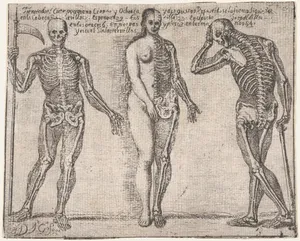
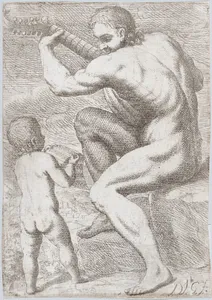
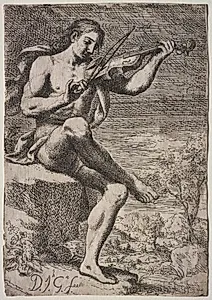
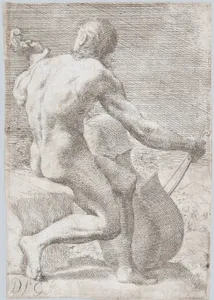
Hidalgo's style blended the archaic tenebrism and dry coloring of the Valencian school with the robust, crowded narratives of Madrid's Baroque tradition, excelling particularly in portraits influenced by Carreño. His legacy endures through his theoretical writings, notably *Principios para estudiar el nobilísimo y real arte de la pintura* (1691), a richly illustrated manual on drawing, anatomy, and aesthetics that disseminated Baroque principles to students across Iberia. As the foremost propagator of Valencian Baroque painting, his works grace collections in Madrid, Valencia, and Segovia, cementing his role in Spain's artistic golden age.