Josef Albers, born on March 19, 1888, in Bottrop, Westphalia, into a Roman Catholic family of craftsmen, received early practical training from his father, Lorenzo Albers, a housepainter and carpenter, mastering skills in engraving glass, plumbing, wiring, and printmaking. After working as a schoolteacher in Bottrop from 1908 to 1913, he trained as an art teacher at the Königliche Kunstschule in Berlin (1913–1915) and as a printmaker at the Kunstgewerbschule in Essen (1916–1919), where he studied stained-glass making under Johan Thorn Prikker. In 1919, he attended the Königliche Bayerische Akademie der Bildenden Künste in Munich as a pupil of Max Doerner and Franz Stuck. Albers enrolled in Johannes Itten's preliminary course at the Weimar Bauhaus in 1920, joining the faculty as a stained-glass instructor in 1922 and rising to professor in Dessau by 1925, the year he married fellow Bauhaus artist Anni Fleischmann, a pioneering textile designer.
Pioneering geometric abstraction in the Bauhaus tradition, Albers emphasized color's relativity and perceptual illusions, viewing it as deceptive and experiential rather than fixed. Fleeing Nazi persecution after the Bauhaus closed in 1933, he and Anni emigrated to the United States, where he became head of the painting program at Black Mountain College (1933–1949), mentoring talents like Robert Rauschenberg and Cy Twombly, before leading Yale's design department (1950–1958), shaping figures such as Eva Hesse. His teaching prioritized hands-on exploration of materials and form, influencing Op Art, hard-edge painting, and conceptual art.
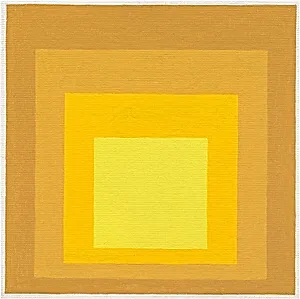
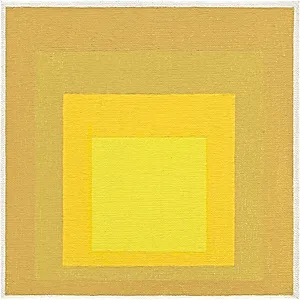
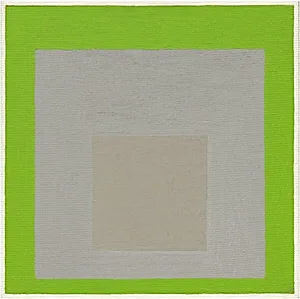
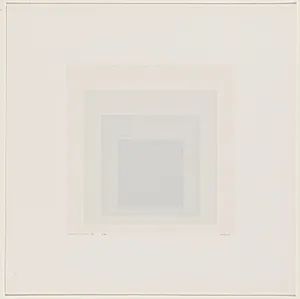
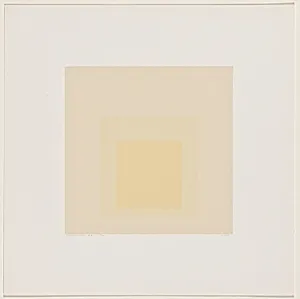
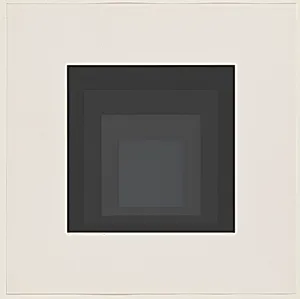
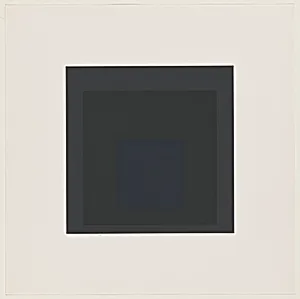
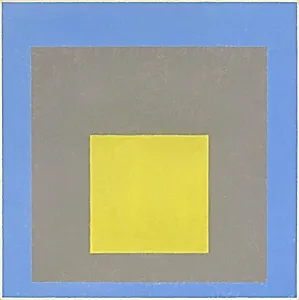
Albers's signature *Homage to the Square* series, begun in 1949, comprises over 1,000 oil paintings on Masonite—nested squares applied with a palette knife to probe chromatic interactions, with colors meticulously noted on the reverse. Other landmarks include *Structural Constellations* prints, early stained-glass like *Rosa mystica ora pro nobis* (1918), and murals such as *Manhattan* (1960s, sandblasted glass). His seminal 1963 book *Interaction of Color*, with silk-screen plates, revolutionized color education. Albers's legacy endures through the Josef and Anni Albers Foundation (1971), the Josef Albers Museum in Bottrop, and his status as the first living artist with a solo Metropolitan Museum retrospective (1971), cementing his role as a transformative educator and color theorist until his death on March 25, 1976.