
Ctrl K
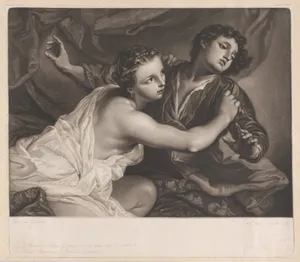
**Joseph Adrianus Clarot (ca. 1770–1820)** was an Austrian engraver and printmaker active primarily in Vienna. Born in Brussels, he spent his professional life in the Austrian capital, where he specialized in mezzotint and etching techniques. His work focused on reproductive prints after paintings by earlier masters, contributing to the dissemination of Baroque and Rococo imagery in the late eighteenth and early nineteenth centuries.
Early life details remain sparse beyond his birthplace and approximate birth year. Clarot established himself as a skilled engraver in Vienna, producing high-quality mezzotints that captured the dramatic lighting and emotional intensity of the originals he reproduced. He worked after artists including Giambettino Cignaroli and Jusepe de Ribera, adapting their compositions for print audiences across Europe.
One of his notable works is the 1793 mezzotint *Joseph and Potiphar’s Wife*, a proof before letters after Cignaroli’s painting. This biblical scene exemplifies Clarot’s mastery of tonal gradation and rich blacks characteristic of the mezzotint medium. Other prints, such as those after Ribera, further demonstrate his range in translating oil paintings into graphic form.
Clarot’s prints are held in major collections including the Metropolitan Museum of Art and the British Museum, preserving his contribution to Viennese printmaking traditions. Though his personal biography is not extensively recorded, his technical skill ensured that important paintings by earlier Italian and Spanish masters reached wider audiences through affordable and finely executed reproductions. His output reflects the vibrant artistic exchange between painting and print culture in the Habsburg capital at the turn of the nineteenth century.