
Ctrl K
1775–1800
**Joseph de Frías** (active ca. 1775–1800) was a Spanish guitar maker based in Seville and Cádiz during the late eighteenth century. Little is known of his personal life or training, as biographical details remain sparsely recorded beyond his professional activity in the southern Spanish centers of instrument making.
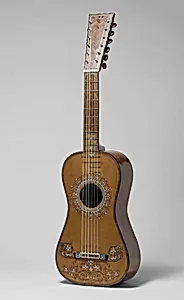
De Frías worked within the established Spanish tradition of guitar construction, producing instruments suited to the six-course (twelve-string) guitars popular in the period. His attributed work demonstrates refined craftsmanship typical of Andalusian luthiers, featuring decorative inlays of mother-of-pearl, rosewood, and ebony, along with distinctive structural choices such as a five-piece soundboard and reinforcement using woven cloth in an X-pattern rather than conventional fan bracing.
The sole known instrument firmly linked to him is a nearly pristine guitar dated circa 1780, now in the collection of the Metropolitan Museum of Art in New York. This example, acquired in 1992, showcases ornate floral motifs around the soundhole and bridge area, ebonized bindings, and a mahogany neck with rosewood elements. Its excellent state of preservation offers valuable insight into late-eighteenth-century Spanish guitar making.
Though documentation of de Frías’s career is limited, his attributed guitar stands as a rare surviving testament to the skilled artisans who supplied instruments for both amateur and professional musicians in Enlightenment-era Spain. The piece continues to inform scholars and performers about the evolution of guitar design in the decades before the instrument’s nineteenth-century standardization.