Ctrl K
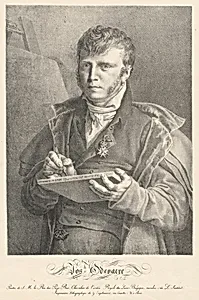
1778–1830
Joseph Denis Odevaere (1775–1830) was a Belgian Neoclassical painter whose career spanned the tumultuous era of the Napoleonic Wars and the establishment of the United Kingdom of the Netherlands. Born in Bruges during the Austrian Netherlands period, Odevaere received elite training in Paris under Jacques-Louis David and Joseph-Benoît Suvée, winning the prestigious Prix de Rome in 1804. His eight years in Italy deeply influenced his development, particularly his devotion to Raphael. Beyond his artistic achievements, Odevaere played a crucial role in cultural restitution, campaigning successfully for the return of major artworks looted from Bruges by French forces. As court painter to King William I, he occupied a prominent position in the artistic establishment of the new kingdom while maintaining his commitment to Neoclassical principles.
Born on December 2, 1775, in Bruges (then part of the Austrian Netherlands), Joseph Denis Odevaere began his artistic education at the Kunstacademie Brugge under François Wynckelman, learning the fundamentals of drawing and painting in the academic tradition.
Odevaere then moved to Paris, the artistic capital of Europe, to continue his studies. He entered the studios of two prominent masters: Joseph-Benoît Suvée, a Belgian-born painter who had settled in France, and Jacques-Louis David, the leading Neoclassical painter and Napoleon's court artist. This training provided Odevaere with rigorous instruction in classical composition, idealized figure drawing, and historical subject matter.
In 1804, Odevaere's dedication was rewarded with the Prix de Rome for his painting The Death of Phocion. This prestigious prize, which funded study in Italy, was the highest honor available to a young artist and confirmed Odevaere's position among the most promising painters of his generation.
Odevaere spent eight years in Italy, traveling to various locations and immersing himself in the study of Renaissance and Classical art. He devoted considerable time to copying the old masters, a traditional method of learning composition, technique, and the principles of ideal beauty.
Among all the masters he studied, Odevaere developed a particular reverence for Raphael, whose balanced compositions, graceful figures, and harmonious coloring profoundly influenced his own artistic development. This period of intensive study shaped Odevaere's mature style and deepened his commitment to Neoclassical ideals.
Following his Italian sojourn, Odevaere returned to the Low Countries and became involved in an important cultural campaign. During the French Revolutionary and Napoleonic Wars, French forces had systematically looted artworks from occupied territories, including precious masterpieces from Bruges.
Odevaere campaigned vigorously for the return of several major works that had been taken from his native city, including pieces by Michelangelo, Jan van Eyck, Hans Memling, and Gerard David. His efforts contributed to the broader European movement for cultural restitution following Napoleon's defeat, and his advocacy helped restore important works to Bruges' churches and museums.
In 1815, following the Congress of Vienna and the establishment of the United Kingdom of the Netherlands, Odevaere was appointed court painter to King William I. This prestigious position recognized his stature as one of the leading artists in the new kingdom and provided him with official commissions and status.
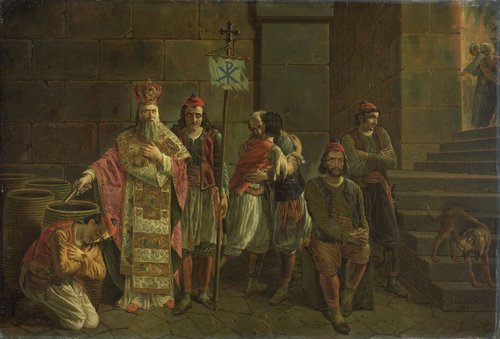
From 1825 to 1829, Odevaere created several works in support of the Greek War of Independence, the struggle of Greek revolutionaries against Ottoman rule that captured the imagination of European intellectuals and artists. During this period, he styled himself Joseph Dionysius Odevaere, adopting a Hellenized version of his name to emphasize his philhellenic sympathies.
Odevaere died on February 26, 1830, in Brussels, just months before the Belgian Revolution that would separate Belgium from the United Kingdom of the Netherlands. His death marked the end of a career that had witnessed dramatic political transformations across Europe.
Artheon Research Team
Last updated: 2025-11-09
Biography length: ~499 words